Welcome to Germany!
Crossing a border: The Eiffel →
Deeper into the Eiffel 🇩🇪 on the Mosel
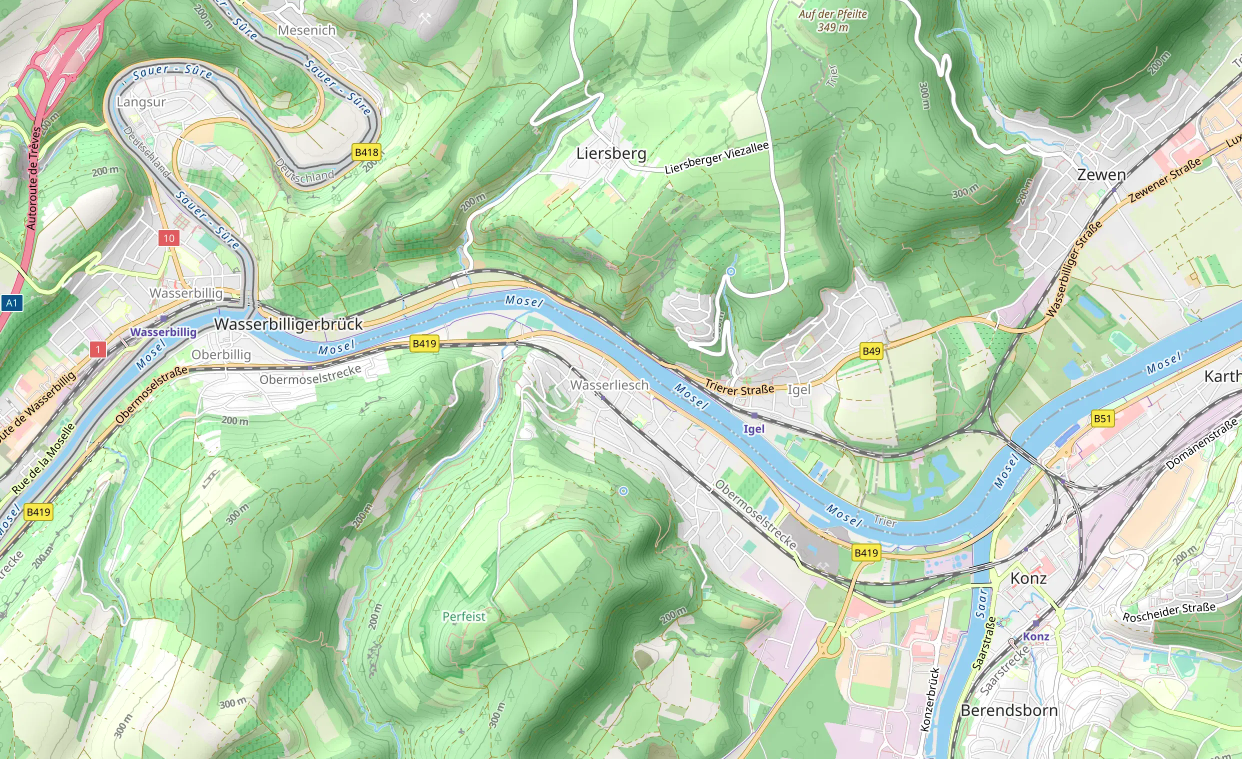
And by leaving Wasserbillig 🇱🇺 we just entered Germany 🇩🇪!
Where the Sauer River flows into the Mosel, the banks of the Sauer river (🇫🇷 = Sûre) are the border between Luxembourg 🇱🇺 and Germany 🇩🇪. This is the other border between the two countries.
So passing the Sauer river heading towards Konz 🇩🇪 implies:
We are now completely in Germany 🇩🇪!
And we are still on the Mozel (Mosel, Moselle, Moezel) river and continuing down-stream.
By doing so, we are heading deeper and deeper into the german Eiffel 🇩🇪.
Options - Options? - Options!
From here navigating towards the entrance of the Saar river at the intersection of the Mosel and the Saar at Konz 🇩🇪.
Here is the possibility to make a small detour towards Saarburg 🇩🇪 where there is a very nice marina at Saarburg 🇩🇪 that is worth the visit because in Saarburg 🇩🇪 (from our humble point of view) you get the BESTApfelstrudel EVER!. At Le Petit Café you find your perfect fill of Apfelstrudel! Although Apfelstrudel is original from Austria-Hungaria, (where Jacco had it at several locations in that region) this is still the best!
So, this is where you have to make a choice. To go to Saarburg or just stop at WSC Konz and visit Trier from there.
Bypass Saarburg and visit Trier?
Going to Saarburg is our choice!
It does not have to be your choice! But if you want to visit Trier,
we want to suggest that you get to the marina of WSC Konz at KM 200.
From this marina there is way better public transportation
available than at the marina of WSC Trier. The Train towards Trier
is only 500 meters away from WSC Konz, as where public transportation
is around 1 hour walk away from WSC Trier (KM 197.4). Things are different
when you have your own transportation with you. That is simple.
If you choose to skip Saarburg, than go to Day 1 to Konz and if you want to go to Saarburg: Day 1 to Saarburg.
And what are we going to navigate?
Wasserbillig 🇱🇺 to Konz 🇩🇪
Day 1: Towards the Saar river
Entering the Eiffel 🇩🇪
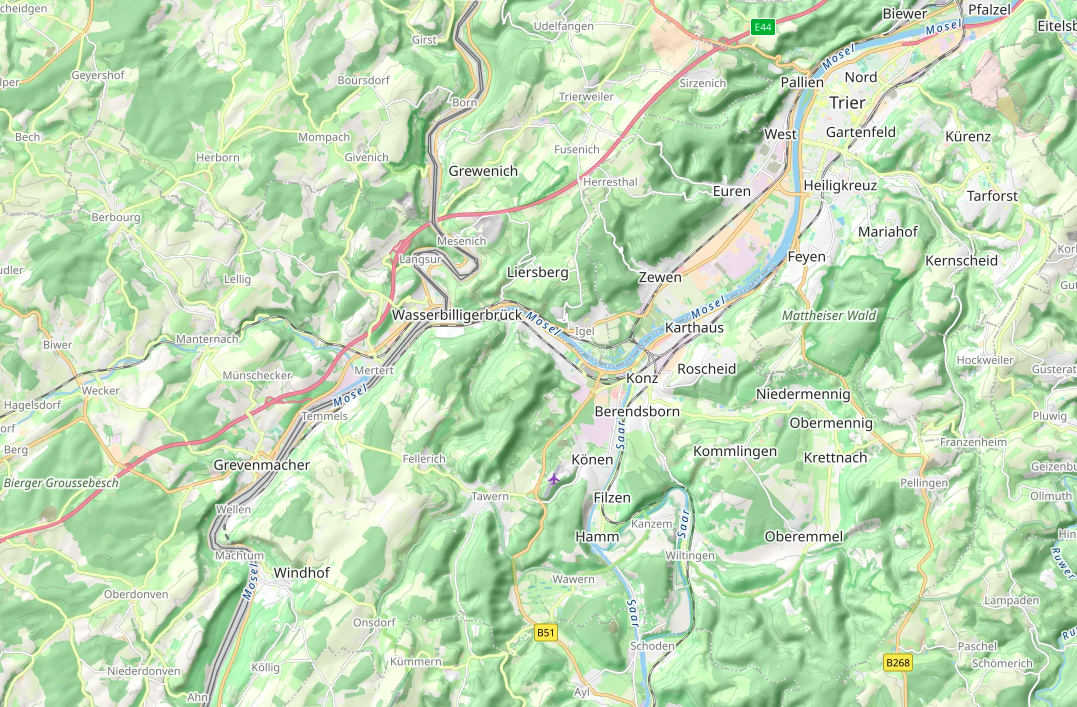
This is a section with only buoys on the 5 km stretch. Not impressive, until you notice that this small section enters the more mountain-rich Eiffel area. Both the Saartal and Moseltal come together here and from here the Mosel will get deeper into the Eiffel. Getting from (globally) south-west into the Eiffel, is a beautiful experience. This very old vulcanic area shows us how resiliant nature truly is.
The city of Trier shows how important this entry already was in Roman times. The Porta Nigra is one of the buildings that still reside in Trier from that period. Now it might also become clear that we don't just visit Saarburg for Apfelstrudel...... We are also here for the historical sites.
Down here you find some extra information regarding those 5 kilometers. It is not how you are used to, but it provides you enough info to safely enter the Saar river.
To the Mosel Days IndexWasserbillig 🇱🇺 → Konz 🇩🇪 Summary
Distance5 kmETA (hh:mm)00:30NoteThis is following the Mosel from the intersection with the Sauer river for 5 km to Konz, where the entrance to the Saar river is. Along this stretch there are buoys on both sides:
Green on the left bank, and
Red on the right bank of the river.
Looking downstream, left side is left bank, and right side is right bank. But when you go upstream, the riverside on your right hand side, is still the left bank of the river! And the left hand side, is then automatically the right bank of the river. After 5 km, the Saar river will be on the right side of the river. (A.K.A the right bank of the river, And also YOUR right hand side, because this is looking down stream)
You might want to visit our page explaining this.
Entering the SAAR at Konz 🇩🇪
Day 1: Heading to Saarburg
Apfelstrudel, here we come!
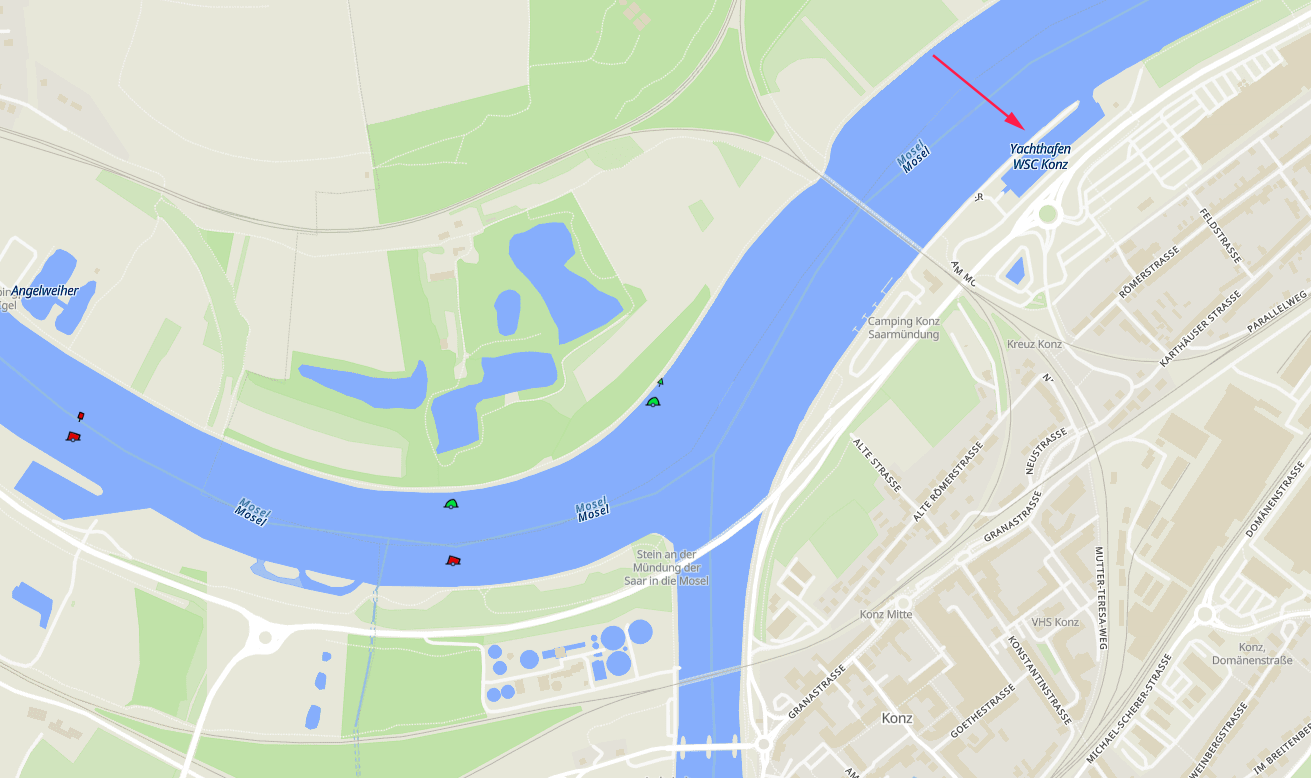
Arriving at the intersection at Konz, we have to make sure that we do not trouble any professionals on the Mosel, or even coming from the Saar river. And we also need to see how fast the current is to enter the Saar river. The best is always to enter going "upstream" when you want to enter another waterway attached to a river.
To safely enter the Saar river at Konz, we are going to continue on the Moselle (Mozel, Moezel) until we are at the Yachthafen WSC Konz (KM 200) where there is enough space, and proper line of sight to make a safe u-turn. There is also a sign that you are allowed to make a U-turn here.
This is after passing the Konzer Moselbrücke!
WARNING! DO NOT MAKE A RIGHT TURN DIRECTLY INTO THE SAAR RIVER! If you do so, you are already causing an accident, because you will end up on the shore!
⚠️Properly look around you, also behind you!⚠️
Passing the the mouth of the Saar is a good indicator of the current(s) there. This way you can anticipate on how you are going to enter the mouth of the Saar river.
⚠️Properly look around you, also behind you!⚠️
Saar:👉 Approximate average current speed of the Saar: ~1–2 km/h (≈ 0.3–0.6 m/s) under typical conditions.
Mosel👉 Best practical estimate (not an official hydrological measurement): the Mosel’s average current speed around Konz is likely in a similar range or somewhat higher than the Saar but generally modest, and heavily dependent on stage/discharge. It is often in the range 1–5 km/h (≈ 0.3–1.4 m/s) under normal river conditions. This is based on typical river behaviour and historical guides, not precise official local statistical data.
Due to these speeds, you understand that it is important to enter the Saar river going UPSTREAM!
Saarburg and Public Transport
One of the advantages of Saarburg is the fact that there is a railway station. From Saarburg you can easy get to Trier, Konz, Bitburg, Luxembourg, and Thionville in a very easy way. Tickets can be ordered on DB site. Example:You are in less than 20 minutes in the heart of Trier (Hbf), or on the left bank of the Mosel (Trier-Pallien)
At Trier Hbf you find connections to many locations.
The route of today
On this section of the route you will pass the objects:
Nearby Services - Sportboothafen Saarburg
-
Closest Supermarket: WASGAU Frischemarkt
Location: Heckingstraße 12-14, Saarburg
Distance: Approx. 900m (12-minute walk towards the town center)
Best for: Fresh local produce, an excellent bakery, and a butcher shop in the heart of town. -
Main Supermarket Hub: REWE Center
Location: Am Leukbach 2-4, Saarburg
Distance: Approx. 1.1 km (14-minute walk)
Best for: A very large selection including non-food items, a beverage market, and long opening hours (until 10:00 PM). -
Note on Fuel: Nearest Station (Road Only)
Status: There is no fuel station directly on the quay for boats.
Nearest option: Shell Station (Im Hagen 23), approx. 800m walk from the harbor.
Alternative: 24h Autohaus Werner at Graf-Siegfried-Straße.
Recommendation: These stations are only accessible by road; a jerrycan or trolley is required for larger quantities of fuel.
At Konz 🇩🇪 re-enter the MOSEL
Day 21: Leaving the Saar river
Tummy Full - Let's Go!
Yes! If everything went fine, tummy is full with Apfelstrudel and other perfect foods from Saarburg! Also, the stores nearby gave us great opportunities to restock.
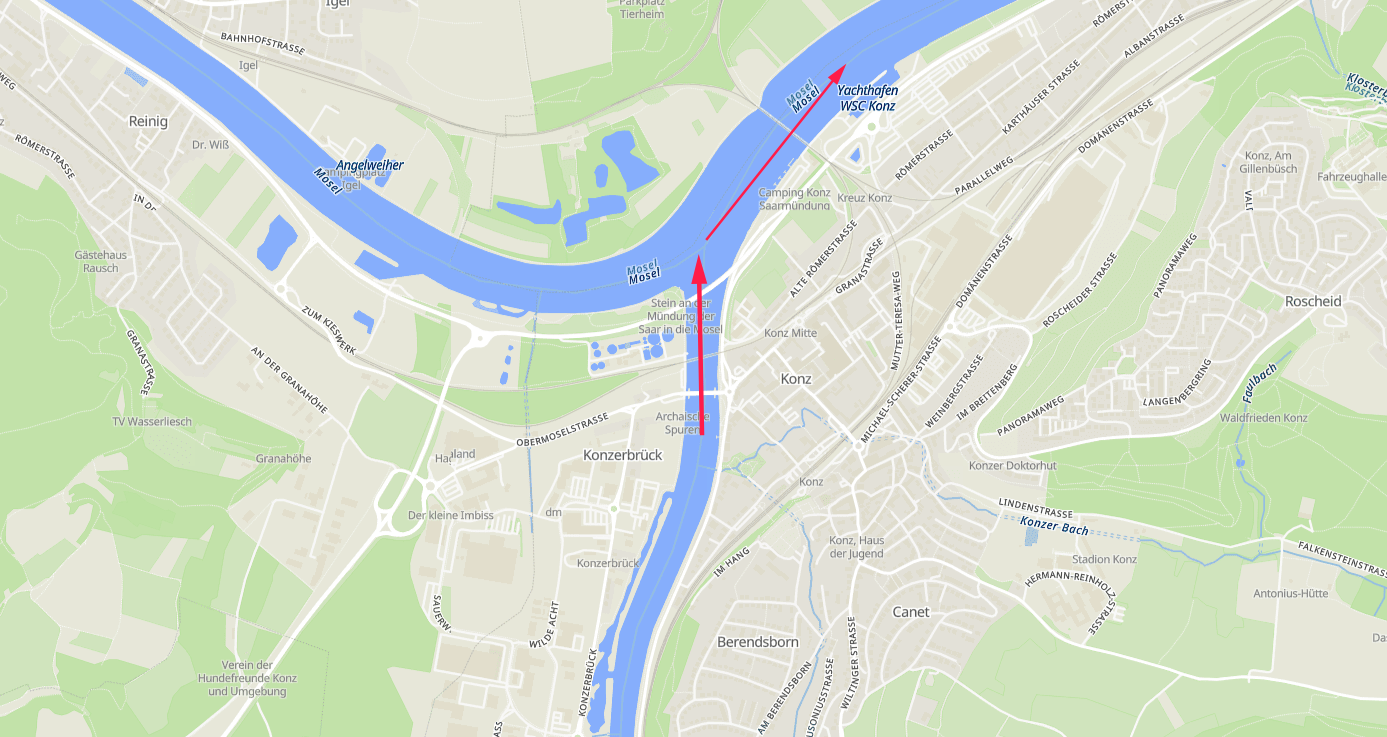
After visiting Saarburg we head back to the Mosel river, so when it is time to go, we are going to pass the objects as mentioned coming here, in reverse sequence. And that takes us back to Konz to continue our route on the Mosel.
The route of today
On this section of the route you will pass the objects:
Re-entering the Mosel at Konz
When leaving the Saar, turn directly to starboard (right). Before you do so, always check whether it is safe to enter the main waterway. If you have AIS available, use it. AIS allows you to see which vessels are nearby, especially at the mouth of the Saar. Professional ships are required to use AIS, so this gives you a reliable picture of commercial traffic in the area.
Do not rely on AIS alone. Use your marine radio (Marifoon) to listen for traffic information, and keep a constant visual lookout. Your eyes, AIS, and radio together are your most important tools here. By combining these, you can better judge the speed, direction, and intentions of other vessels before you commit to the turn.
Be aware that this area can have currents coming from different directions at the same time. These mixed currents can affect how your boat responds to steering and throttle, sometimes in unexpected ways. Because of this, be prepared for sudden changes in handling and always make sure you have enough space to manoeuvre safely.
Take your time, anticipate the movement of both your own vessel and others, and only proceed when you are confident that conditions allow for a safe and controlled entry.
To enter the Mosel safely, you must leave the Saar under way. At this location the river current does not allow you to stop, loiter, or go astern. Maintain forward motion on the Saar while actively monitoring traffic visually and via AIS.
Actively observe traffic in all directions, including astern.
Saar: 👉 Approximate average current speed of the Saar: ~1–2 km/h (≈ 0.3–0.6 m/s) under typical conditions.
Mosel 👉 Best practical estimate (not an official hydrological measurement): the Mosel’s average current speed around Konz is likely comparable to or slightly higher than the Saar, but highly dependent on water level and discharge. Typical values are often in the range of 1–5 km/h (≈ 0.3–1.4 m/s) under normal river conditions. This estimate is based on typical river behaviour and historical navigation guides, not precise local statistical data.
Because of these current speeds, it is essential to anticipate both the Saar outflow and the Mosel current coming from upstream before committing to the manoeuvre.
To the Mosel Days IndexFrom Konz 🇩🇪 to Koblenz 🇩🇪
Back on the Mosel
Continuing down on the Mosel 🇩🇪 River
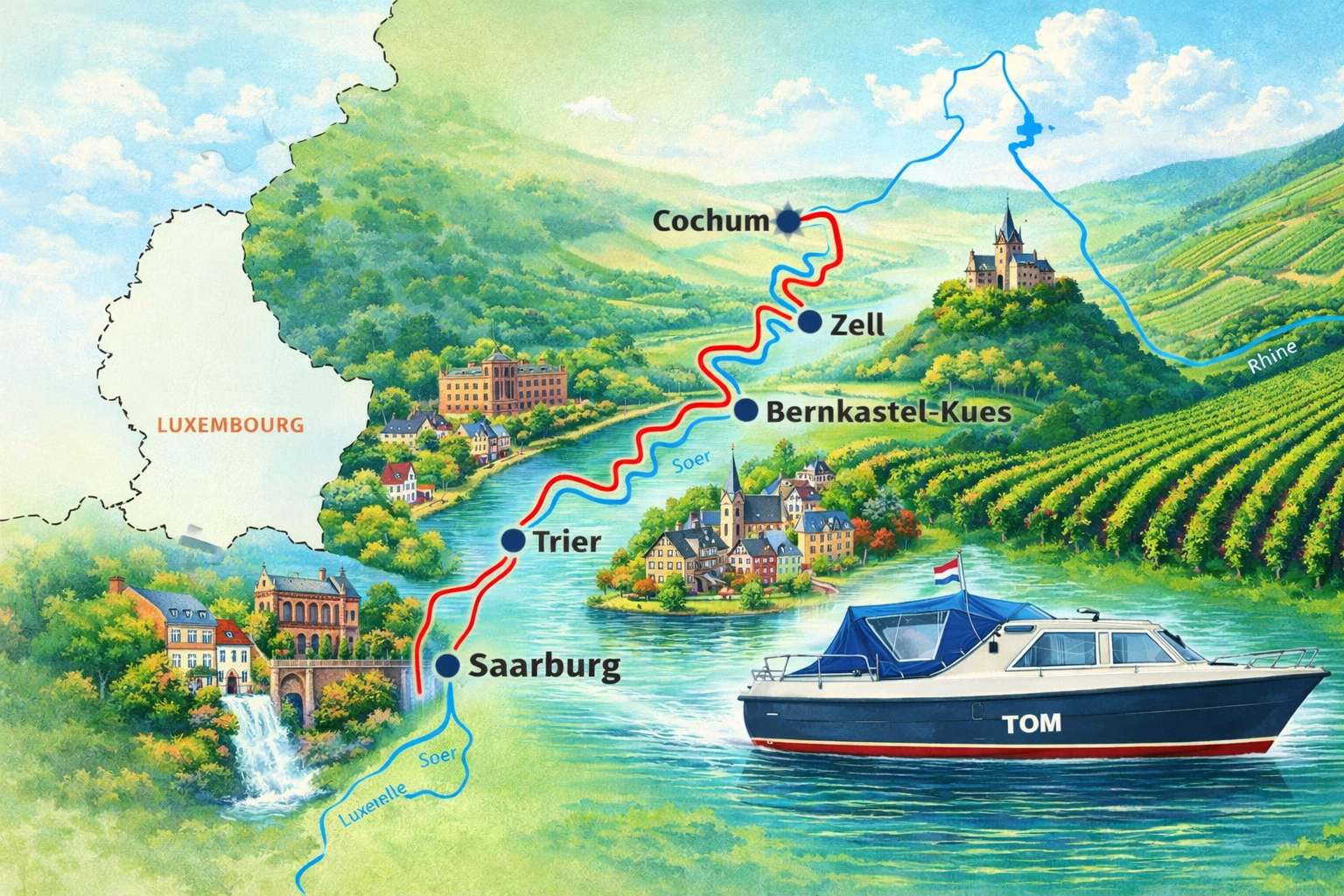
When you chose to visit Saarburg 🇩🇪 than you already passed the Konzer Moselbrücke two times. Otherwise, this will be your first pass. Whenever you want to visit Trier, than we advise you to visit the Yachthafen WSC Konz because public transportation is way closer to this marina, than when you stay at WSC Trier. But when you have bikes with you, than WSC Trier is a perfect stay too.
So continuing down-stream, at KM 200 we will find the entrance to the Yachthafen WSC Konz.
From here the Real Mosel experience starts. So make sure you prepare, so you don't miss anything because you are way to busy along the way from here to Koblenz. Because to get there, is still some way to go and alot to see and experience. While in the region, you might want to consider buying wines from here. At least, we assume you have some spare storage space onboard.
Regulated River, that is what the Mosel is from here on. There are sections between locks. And those sections are carefull managed to keep the water-leves at a normal. Because of that, there are locks along the route. There are no side-canals, like there are in France on the Meuse river.
⚠️Reminder⚠️
Warning: Commercial vessels here may travel up to 16 km/hr (8.5 knots), covering 1 km in about 4 minutes. Large ships can reach you faster than expected. Keep a constant lookout.
WSC Konz 🇩🇪 at KM 200
Visiting Trier 🇩🇪 by train
Only minutes on the Mosel 🇩🇪 River
Yes, this section seems a bit silly, but we have to start somewhere, right? So you choose to visit Trier 🇩🇪 by train. Than the marina of WSC Konz is a good choice. From here, you have within 15 minutes walking, access to trainstations from where you can get to beautiful places, like Trier, Luxembourg among others. So yes, it might be a very short trip, but worth it if you don't have bikes with you on board.
The route of today
On this section of the route you will pass the objects:
Nearby Services - Yachthafen Konz
-
Closest Supermarket: Kaufland Konz
Location: Saar-Mosel-Platz 2, 54329 Konz
Distance: Approx. 800m (10-minute walk from the harbor)
Best for: An extensive selection of groceries, a bakery, organic products, and daily essentials. -
Alternative Supermarket: Lidl
Location: Schillerstraße 2, 54329 Konz
Distance: Approx. 1.2 km (15-minute walk)
Best for: Budget-friendly groceries and weekly discount offers. -
Note on Fuel: Nearest Station (Road Only)
Status: There is no dedicated marine fuel station directly on the quay at Yachthafen Konz.
Nearest option: Aral (Schillerstraße 1) or ED Tankstelle (Saarstraße 41), both within a 1.2 km walk.
Recommendation: These stations are accessible by road; for larger quantities of fuel, a trolley or jerrycan is required as they do not offer direct waterside service.
To Bernkastel 🇩🇪
Passing Trier 🇩🇪
Eiffel 🇩🇪 winefields upto Bernkastel 🇩🇪
After visiting Trier, following the Mosel to Bernkassel 🇩🇪 is a pleasure to the eye. Passing all those grapevines in the vinyards, the steap mountains. With every kilometer they become steaper and higher.
The route of today
On this section of the route you will pass the objects:
Nearby Services - Bootsclub Bernkastel 2000 e.V. (Bernkastel-Kues)
-
Closest Supermarket: REWE Center
Location: Adolf-Kolping-Straße 1, Bernkastel-Kues (Kues side)
Distance: Approx. 850m (11-minute walk from the harbor)
Best for: A massive selection of groceries, a bakery, and a large beverage market. -
Alternative Supermarket: EDEKA
Location: Friedrichstraße (Forum area), Bernkastel-Kues
Distance: Approx. 1.1 km (14-minute walk)
Best for: High-quality fresh produce and a convenient central location in the Kues district. -
Note on Fuel: No Waterside Fuel Station
Status: There is no dedicated marine fueling station at the harbor.
Nearest option: Aral or bft Tankstelle (approx. 1.5 - 2 km walk).
Recommendation: These stations are only reachable by road. Plan to use a trolley or jerrycans for refueling, as they are not directly accessible by boat.
To Traben Trarbach 🇩🇪
Day 2: Leaving Bernkastel 🇩🇪
Enjoying the view of the 🇩🇪 winefields
The Mosel is now meandering along mountains with amazing buildings and huge amounts of winefields. Passing small towns like Ürzig 🇩🇪 that is truly squeezed between the river and the mountains. Those steap mountains. With every kilometer they become steaper and higher.
The route of today
On this section of the route you will pass the objects:
Nearby Services - Yachthafen Traben-Trarbach (WSC)
-
Closest Supermarket: EDEKA Heckler
Location: Am Bahnhof 9, Traben-Trarbach
Distance: Approx. 800m (10-minute walk from the harbor)
Best for: Large selection of groceries, fresh regional products, and an in-store bakery. -
Main Discount Hub: ALDI Süd
Location: Am Bahnhof 11, Traben-Trarbach
Distance: Approx. 850m (11-minute walk)
Best for: Budget-friendly shopping; located right next to the EDEKA for convenience. -
Note on Fuel: Boat Refueling Station Available
Status: Unlike many other stops, there is a dedicated **Boat Refuelling Station** nearby.
Nearest option: Boote Polch (Enkircher Straße 41) provides waterside refueling.
Road Alternative: ED Station (Rißbacher Str. 125) is about 900m away for jerrycan refills.
Recommendation: Check operating hours for the waterside pump at Boote Polch, as they may differ from road station hours.
To Senheim 🇩🇪
Day 3: Leaving Traben Trarbach 🇩🇪
As the Mosel 🇩🇪 twists
Bends as tight as a hairpin, so it might seem you are heading back. This already starts at Neef 🇩🇪. The mountains here are just a bit steeper and the water found its way around and down, leaving a beautiful view.
The Mosel is now meandering along mountains with amazing buildings and huge amounts of winefields. Passing small towns like Neef 🇩🇪 that is truly squeezed between the river and the mountains. With every kilometer they become steaper and higher.
The route of today
On this section of the route you will pass the objects:
Nearby Services - Yachthafen Senheim
-
Closest Supermarket: Camping Shop Senheim
Location: Am Campingplatz 1, Senheim
Distance: Located directly at the harbor/campsite entrance.
Best for: Daily essentials, fresh bread rolls (Brötchen), and basic groceries without leaving the site. -
Main Supermarket: Globus Zell or REWE Cochem
Location: Briedeler Weg 1, Zell (Mosel) or Cochem center.
Distance: Approx. 10–12 km (requires a bike, taxi, or bus).
Best for: Extensive provisioning and specialized items not found in the village. -
Note on Fuel: Convenient Roadside Station Nearby
Status: While there is no pump on the water, there is a station very close by.
Nearest option: ED Tankstelle (Zeller Str. 36).
Distance: Approx. 850m (10-minute walk from the marina).
Recommendation: This is one of the more accessible road stations for boaters; easy to reach with a trolley or jerrycans.
To Cochem 🇩🇪
Day 3: Leaving Senheim 🇩🇪
As the Mosel 🇩🇪 twists
Bends as tight as a hairpin, so it might seem you are heading back. This already starts at Neef 🇩🇪. The mountains here are just a bit steeper and the water found its way around and down, leaving a beautiful view.
The Mosel is now meandering along mountains with amazing buildings and huge amounts of winefields. Passing small towns like Neef 🇩🇪 that is truly squeezed between the river and the mountains. With every kilometer they become steaper and higher.
The route of today
On this section of the route you will pass the objects:
Nearby Services - Yachthafen Cochem-Cond (YCC)
-
Closest Supermarket: REWE Markt
Location: Am Markweg 3, 56812 Cochem (Cond district)
Distance: Approx. 600m (8-minute walk from the marina)
Best for: Full grocery range, fresh regional products, and long opening hours (until 10:00 PM). -
Main Shopping Hub: Penny Market
Location: Sehler Anlage 19, 56812 Cochem
Distance: Approx. 1.1 km (14-minute walk across the Skagerak-Bridge)
Best for: Discount groceries; located on the opposite bank in the Sehl district. -
Note on Fuel: Nearby Roadside Station
Status: There is no fuel pump directly at the water for boats.
Nearest option: Shell Station (Moselstraße 23).
Distance: Approx. 900m walk from the marina across the bridge.
Recommendation: This is a convenient roadside station for jerrycan refills, accessible via a short walk over the bridge to the main town side.
To Koblenz 🇩🇪
Day 4: Leaving Cochem 🇩🇪
Where the Mosel 🇩🇪 connects to the Rhine 🇩🇪
Bends as tight as a hairpin, so it might seem you are heading back. This already starts at Neef 🇩🇪. The mountains here are just a bit steeper and the water found its way around and down, leaving a beautiful view.
The Mosel is now meandering along mountains with amazing buildings and huge amounts of winefields. Passing small towns like Neef 🇩🇪 that is truly squeezed between the river and the mountains. With every kilometer they become steaper and higher.
The route of today
On this section of the route you will pass the objects:
Nearby Services - Yachthafen Cochem-Cond (YCC)
-
Closest Supermarket: REWE Markt
Location: Am Markweg 3, 56812 Cochem (Cond district)
Distance: Approx. 600m (8-minute walk from the marina)
Best for: Full grocery range, fresh regional products, and long opening hours (until 10:00 PM). -
Main Shopping Hub: Penny Market
Location: Sehler Anlage 19, 56812 Cochem
Distance: Approx. 1.1 km (14-minute walk across the Skagerak-Bridge)
Best for: Discount groceries; located on the opposite bank in the Sehl district. -
Note on Fuel: Nearby Roadside Station
Status: There is no fuel pump directly at the water for boats.
Nearest option: Shell Station (Moselstraße 23).
Distance: Approx. 900m walk from the marina across the bridge.
Recommendation: This is a convenient roadside station for jerrycan refills, accessible via a short walk over the bridge to the main town side.
At Koblenz 🇩🇪
Day 1: The Rhein at Koblenz 🇩🇪
Where the Mosel 🇩🇪 connects to the Rhine 🇩🇪
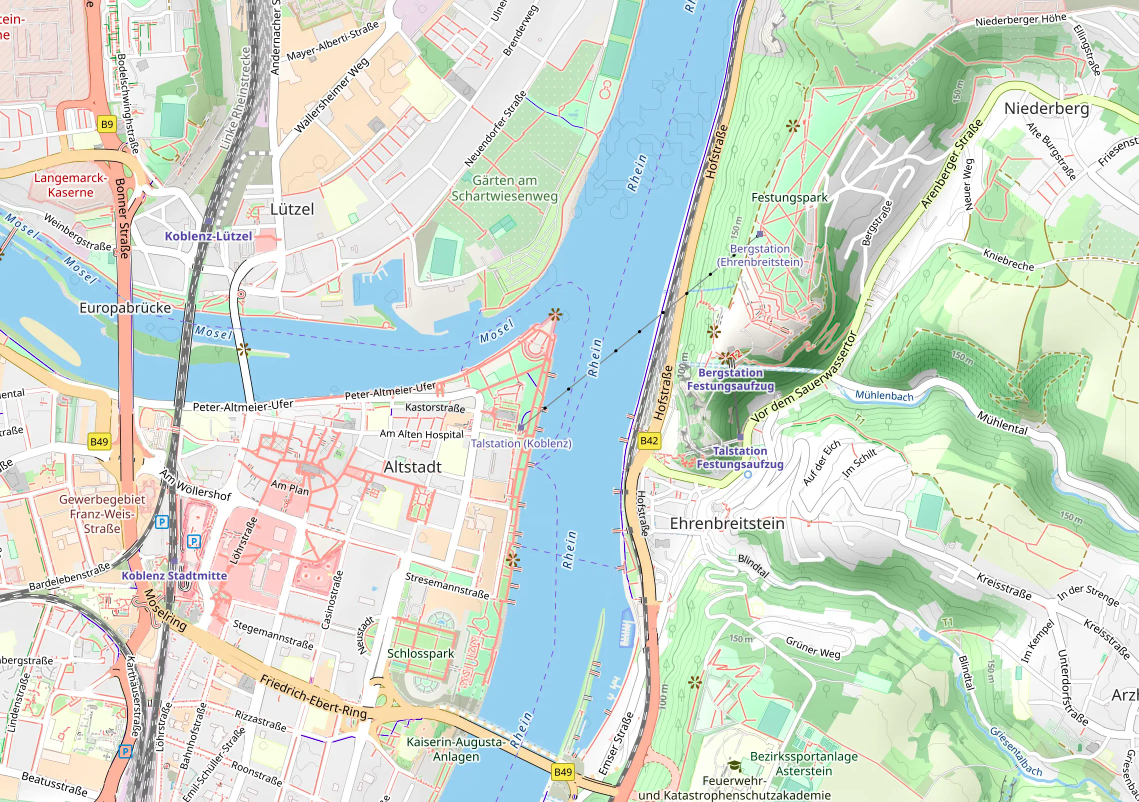
From the spires of Koblenz to the North Sea gates of Rotterdam.
The Grand Artery
As the sun rises over the Deutsches Eck in Koblenz, the water begins to churn. This isn't just a scenic vista; it is the view over Europe's most vital logistics corridor. Between the Dutch city of Rotterdam and Koblenz, and even beyond, the Rhine is the liquid highway, acting as the primary artery pumping lifeblood (cargo) from the Port of Rotterdam deep into the heart of the continent.
Every vessel trailing a wake represents a mountain of goods: raw minerals for the Ruhr, chemicals for Basel, and thousands of containers destined for kitchen tables across Germany. Without this stretch of water, the gears of European industry would grind to a halt.
German Engineering vs. Mother Nature
The Germans view the Rhine not as a static landmark, but as a high-precision machine that requires constant tuning. Maintaining this "main artery" is a Herculean task of engineering and vigilance:
- Dredging & Depth: To combat the increasing frequency of low-water summers, German authorities are engaged in the Abladeoptimierung (Navigation Optimization) project. This ensures that even during droughts, deep-draft barges can still pass without grounding.
- Lock & Dam Modernization: Millions of Euros are funneled annually into digitizing and reinforcing the infrastructure to ensure 24/7 uptime for cargo traffic.
- Ecological Balance: Maintenance isn't just about concrete; it's about stability. German environmental agencies work tirelessly to reinforce banks and manage sediment, ensuring the river remains a sustainable resource for future generations.
⚠️ Warning⚠️ Upstream to the marina
⚠️ Be aware of the current on the Rhein! Make sure you check the current waterspeed. The table down here gives you some indication of how fast the water will flow. On Euris you will find the actual water level measurements. On PegelOnline you will find the other source of the actual waterlevel at Koblenz.
| Water Level (Gauge Koblenz) |
Current Speed (km/h) | Status & Navigation Notes |
|---|---|---|
| Low Water (< 150 cm) | 2.9 – 4.0 km/h | Low flow; restricted draft for cargo vessels. |
| Average Water (approx. 300 cm) | 4.3 – 5.4 km/h | Standard conditions; average flow of ~1.6 m/s. |
| High Water (> 500 cm) | 6.5 – 9.0 km/h | Strong currents; shipping suspended above 650 cm. |
⚠️ Do not UNDERESTIMATE the current!
Caution ⚠️
Please make sure your vessel is capable of fighting the current
while you are going in the Opvaart
Opposing the Parel, We advise a little quieter marina, closer to the city. Actually on the left bank of the Rhine. This marina is Hafen Yachtclub Rheinlache. Yes, this implies that the boat has to work, but it will be worth it.
We are going to stay at Yachtclub Rheinlache Koblenz e.V
Because the pontoons of Marina Rhein-Marina Kaiser Wilhelm are virtually facing the Rhein, wash will be entering rocking them. Larger vessels are less affected by the swell entering the harbor, as the pontoons are located relatively close to the main fairway. However, because the Rhine is a busy shipping route used 24/7 by heavy cargo ships and tankers, their constant wash creates significant movement in the water. While larger ships remain stable, smaller vessels can end up 'dancing' quite vigorously in these waves, making it essential to secure your lines properly.
The route of today
On this section of the route you will pass the objects:
Nearby Services - Yachtclub Rheinlache (Koblenz)
-
Closest Supermarket: REWE Markt
Location: Mainzer Straße 120, 56068 Koblenz
Distance: Approx. 650m (8-minute walk from the marina)
Best for: Full grocery range, fresh produce, and a bakery; very convenient for a quick restock. -
Main Shopping Hub: Lidl & dm-drogerie
Location: Mainzer Straße 124-126, Koblenz
Distance: Approx. 750m (9-minute walk)
Best for: Budget-friendly groceries and drugstore essentials, located right next to the REWE. -
Note on Fuel: Convenient Roadside Station Nearby
Status: There is no fuel pump directly at the water for boats at this club.
Nearest option: Aral Station (Mainzer Str. 114).
Distance: Approx. 600m (7-minute walk from the harbor).
Recommendation: This is one of the most accessible road stations for boaters in Koblenz; easy to reach with a trolley or jerrycans via a flat walk.
Downstream to Oberwinter 🇩🇪
Day 1: Downstream on the Rhein
Speeding down the Rhein 🇩🇪
Depending on how fast the flow of the Rhein is, the speed (SOG) will be increased by that. By leaving the marina, we have to cross over to the other side of the river. Due to the higher speed of the currents you MUST make sure that you can cross safely! Use your AIS, you Marine Radio and your extra eyes.
During this leg, you will pass some very important historical sites. Among those that where very important in ending the war.
The Remagen Bridge
View Larger Map
At KM 632.8 you find the ruins of the trainbridge at Remagen. This bridge was the actual "breaktrough" that the allies needed to finish the war.
On March 7, 1945, troops of the U.S. 9th Armored Division reached the Rhine and were stunned to find the bridge still standing. The German defenders had attempted to blow it up, but the charges failed to destroy the main structure. American forces quickly charged across under heavy fire, securing the first permanent Allied bridgehead over the Rhine.
This breakthrough was a massive strategic blow to the Third Reich. General Eisenhower famously remarked that the bridge was "worth its weight in gold," as it allowed the Allies to move tanks, troops, and supplies deep into the German heartland much faster than anticipated. It bypassed the need for many risky amphibious assaults and contributed to the rapid collapse of German defenses in the West.
Although the bridge eventually collapsed into the river ten days later due to structural damage and German shelling, the Allies had already established a firm grip on the eastern bank. This success is credited with saving thousands of lives by accelerating the end of the conflict by several weeks.
Significant Allied Rhine Crossings (1945)
Following the capture of the bridge at Remagen, the Allies launched several massive operations to cross the Rhine and enter the German heartland.
Operation Plunder (March 23–24, 1945)
This was a massive, coordinated assault by the 21st Army Group under Field Marshal Montgomery. It involved over one million soldiers and was the primary northern thrust into Germany.
- Wesel: Captured by British Commandos after a heavy aerial bombardment, serving as a vital logistics hub for the push into the Ruhr area.
- Rees: Crossed by the 51st Highland Division, where they faced some of the most determined German resistance during the operation.
- Xanten: A key jumping-off point for Allied forces to establish bridgeheads and link up with airborne troops.
Operation Varsity (March 24, 1945)
The largest single-day airborne operation in history. Over 16,000 paratroopers and thousands of gliders landed near Hamminkeln to seize high ground and silence German artillery overlooking the river crossings.
The Northern Sector (Dutch Border)
Near the towns of Emmerich and Elten, Canadian and British troops forced crossings in late March. These maneuvers were essential for the subsequent liberation of the northern Netherlands and the isolation of German forces in the west of Holland.
These crossings collectively shattered the German "Rhine Defense" and led to the rapid conclusion of the war in Europe.
The route of today
On this section of the route you will pass the objects:
Nearby Services - Yachthafen Oberwinter
-
Closest Supermarket: Edeka Rudolphi
Location: Hauptstraße 133, 53424 Remagen-Oberwinter
Distance: Approx. 200m (3-minute walk from the marina entrance)
Best for: A full-range supermarket with a bakery, fresh produce, and a butchery. Extremely convenient for boaters. -
Alternative Shopping: REWE
Location: Mainzer Straße (Remagen center)
Distance: Approx. 4 km (requires a bike or short train ride)
Best for: Extended shopping trips if specialized items are needed beyond the local Edeka. -
Note on Fuel: Roadside Station Very Close
Status: There is no fuel pump directly on the water, but a road station is nearly adjacent to the harbor.
Nearest option: Free Station / Landtankstelle (B9 / Hauptstraße).
Distance: Approx. 300m (4-minute walk).
Recommendation: This is one of the most convenient stops on the Rhine for manual refueling; easily reached with a trolley or jerrycans via the harbor exit.
Downstream to Köln 🇩🇪
Day 2: Towards the border
Further down the Rhein 🇩🇪
Depending on how fast the flow of the Rhein is, the speed (SOG) will be increased by that. By leaving the marina, we have to cross over to the other side of the river. Due to the higher speed of the currents you MUST make sure that you can cross safely! Use your AIS, you Marine Radio and your extra eyes. And yes, that routine has not changed magically!
During this leg, you will pass some very important historical sites. Among those that where very important during the cold war.
The Cold War
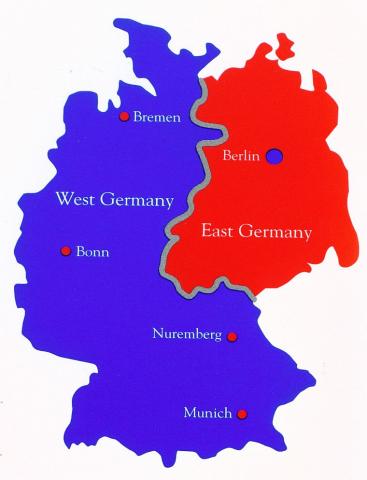
At Bonn was, during the Cold war and when the DDR still existed, the government of Western Germany located. Throughout the entire city, you will find all kinds of reminders of that time. And I forgot to mention the previous day, but you passed the Ahr stream which leads along Ahrweiler, where the Regierungsbunker (Government Bunker) was located. About 25 km south of Bonn, this massive, top-secret, 17.5 km long bunker complex was built between 1960 and 1972 in railway tunnels to house the government in a nuclear emergency. A 200-meter section is now a museum.
Key Cold War Structures in/around Bonn
- Bundeshaus (Federal Parliament) Situated along the Rhine, this complex served as the seat of the Bundestag and Bundesrat, featuring the iconic plenary chamber designed by Günter Behnisch.
- Palais Schaumburg The neoclassical primary seat and residence of the Federal Chancellor from 1949 to 1976.
- Villa Hammerschmidt: Served as the secondary official seat of the President of the Federal Republic of Germany.
- Civil Defense Bunkers: Numerous Cold War-era bunkers (e.g., at Lotharstrasse, Quirinusplatz) were constructed or upgraded, often combined with parking garages or subway systems.
- Embassy District (Bad Godesberg): Many nations maintained embassies in this district, characterized by high security, such as the former US Embassy.
- Haus der Geschichte (House of History): While now a museum, its exhibits focus on the history of the Federal Republic and the Cold War era
It is a shame, however, that there is no marina (or mooring spots) available in Bonn but there is one nearby: Rhein-Yacht-Club Niederkassel-Mondorf e.V. (approx. KM 660). From here it is a short travel (30 minutes) by public transportation to Bonn.
The route of today
On this section of the route you will pass the objects:
Nearby Services - Rheinau-Sporthafen Köln (Rheinauhafen)
-
Closest Supermarket: REWE
Location: Severinstraße 197, 50676 Köln
Distance: Approx. 850m (11-minute walk from the marina)
Best for: Full grocery range and fresh bread; located in the lively Severinsviertel district. -
Main Supermarket: HIT Markt
Location: Siegburger Str. 229 (Deutz side) or **Edeka** (Friedrichstraße)
Distance: Approx. 1.2 km (15-minute walk)
Best for: Massive selection and extensive provisioning; Edeka is closer for high-quality fresh produce. -
Note on Fuel: Rare Waterside Refueling Station
Status: This marina features its own **active waterside fuel station** for boats.
Available: Diesel and Super gasoline are typically available directly at the quay.
Recommendation: It is one of the most convenient fueling stops on the Rhine. Check seasonal hours at the harbor office, as they may vary.
Downstream to Düsseldorf 🇩🇪
Day 3: Closer to Turtle & Tiger
Further down the Rhein 🇩🇪
Depending on how fast the flow of the Rhein is, the speed (SOG) will be increased by that. By leaving the marina, we have to cross over to the other side of the river. Due to the higher speed of the currents you MUST make sure that you can cross safely! Use your AIS, you Marine Radio and your extra eyes. And yes, that routine has not changed magically!
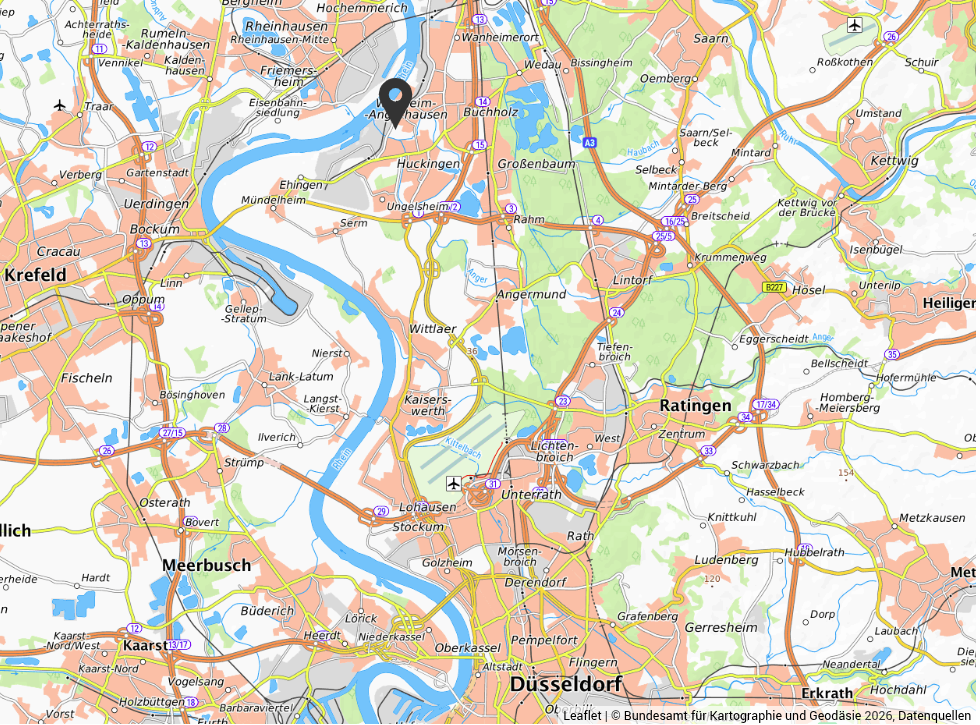
Along this stretch, the entry to the harbours of NEUSS are on the left bank of the Rhein river. This implies that there is a lot of commercial traffic! Be aware and look at your surroundings!
Turtle & Tiger
In between Düsseldorf and Duisburg is on the right bank, Tiger & Turtle is located. This is one of the first trips that we took on our Piagio MP3! So maybe we will add an extra stop to visit it again. It is certainly a fun site to visit. For certain, bring your camera!
Düsseldorf Airport
If you are in a hurry to go somewhere, you can catch a flight from the airport here! Düsseldorf Airport has international flights.
The route of today
On this section of the route you will pass the objects:
Nearby Services - Marina Düsseldorf
-
Closest Supermarket: Netto Marken-Discount
Location: Hammer Straße 30, 40219 Düsseldorf
Distance: Approx. 850m (11-minute walk from the marina)
Best for: Daily groceries and fresh bread; located right on the edge of the Unterbilk district. -
Premium Shopping: REWE Markt
Location: Bilker Allee 57, 40219 Düsseldorf
Distance: Approx. 1.3 km (16-minute walk)
Best for: A larger selection of high-quality groceries and regional specialties. -
Note on Fuel: No Waterside Station
Status: There is no dedicated marine fuel station directly at the marina docks.
Nearest option: Aral (Völklinger Straße) or Shell (Gladbacher Straße).
Distance: Approx. 1.5 km walk.
Recommendation: These road stations are accessible by foot, but it is a longer trek. It is recommended to use a trolley for jerrycans or plan fuel stops in larger hubs with water access.
Downstream to Wesel 🇩🇪
Day 4: Closer to the Dutch Border
Further down the Rhein 🇩🇪
Depending on how fast the flow of the Rhein is, the speed (SOG) will be increased by that. By leaving the marina, we have to cross over to the other side of the river. Due to the higher speed of the currents you MUST make sure that you can cross safely! Use your AIS, you Marine Radio and your extra eyes. And yes, that routine has not changed magically!
Along this stretch, the entry to the harbours of NEUSS are on the left bank of the Rhein river. This implies that there is a lot of commercial traffic! Be aware and look at your surroundings!
The route of today
On this section of the route you will pass the objects:
Nearby Services - Yacht Club Wesel (YCW) / Stadthafen
-
Closest Supermarket: EDEKA Lurvink
Location: Kreuzstraße 11-13, Wesel
Distance: Approx. 2.8 km (8-minute bike ride or 35-minute walk)
Best for: High-quality groceries, fresh regional produce, and a large selection of items. -
Alternative Supermarket: REWE Markt
Location: Friedrichstraße 8, Wesel
Distance: Approx. 4.1 km (10-minute bike ride or 12-minute taxi)
Best for: Comprehensive provisioning and extended opening hours (usually until 10:00 PM). -
Note on Fuel: No Waterside Station
Status: There is no dedicated marine fuel station directly at the harbor docks.
Nearest option: Shell Station (Flürener Weg 84).
Distance: Approx. 2.5 km (30-minute walk or 7-minute drive).
Recommendation: Refueling is best done using a bike or taxi with jerrycans, as the road stations are a significant walk from the marina area.
Downstream to The Netherlands 🇳🇱
Day 5: Crossing the Dutch Border 🇩🇪 → 🇳🇱 →
From Rhein 🇩🇪 to Rijn 🇳🇱
Depending on how fast the flow of the Rhein (Rijn) is, the speed (SOG) will be increased by that. By leaving the marina, we have to cross over to the other side of the river. Due to the higher speed of the currents you MUST make sure that you can cross safely! Use your AIS, you Marine Radio and your extra eyes. And yes, that routine has not changed magically!
Along this stretch, the BORDER will be crossed into The Netherlands 🇳🇱
The route of today
On this section of the route you will pass the objects:
To the Rhein Days Index
Welcome back to The Netherlands!
Crossing the border →
Passing Marker 862.3 (DE)
Which countries will this route pass?
These are the 5 (five) countries we are going to visit. Please use the links to get to the specific chapters (or routes, or legs) of each country.
We added, for good measurement, the ISO Country and the International country-code for calling. There are objects (locks, bridges, etc) that you have to call and do not have any VHF radio. (Or we could not find the VHF information.)
List of Countries
NL - +31
Many canals & rivers (Depending on the chosen route).BE - +32
Mostly Zuid-Willemsvaart, the Albert Canal and the Meuse River.FR - +33
Meuse River, many canals and the Moselle River. Many canals because of the chance of detours.LUX - +352
Moselle River. Shortest stretch.DE - +49
The Moselle, the Saar and the Rhine River.NL - +31
Many canals & rivers (Depending on the chosen route).Of all five countries, we'll only be in Luxembourg for a short stretch: just the section of the Moselle that lies wedged between France, Germany, and Luxembourg. It starts at Écluse d'Apach (FR) and ends at Wasserbillig (LUX), where the Sauer River flows into the Moselle. On this approximately 36 km long stretch, we'll be boating right along the border between Luxembourg and Germany. More about this will follow in the section covering this part of the route.
Support the KNRM!
Help them to help others!
I would like to ask you to become a donor for the KNRM.
The KNRM is a fully private organisation, completely run by volunteers, financed by contributions and donations. You will find all information about them on the website.
You can choose from a single one time payment or a monthly or yearly donation. Please Support them.
Our personal opinion is that every person out on the water should, by law be told to make a donation of €25,- per year. But that is just our opinion.
Copyright, Disclaimer & Attribution
The legal stuff needed because of stupid....
The content on this website may include materials such as text, images, videos, and other media that are the property of their respective owners. All trademarks, logos, and copyrighted works remain the intellectual property of their original creators.
We strive to properly attribute and acknowledge all sources. If you are the copyright owner of any material featured on this site and believe it has been used without appropriate credit or permission, please contact us at [your contact email] so we can promptly address the issue.
Where applicable, the use of third-party content falls under fair use, creative commons licenses, or other applicable legal provisions. If specific attribution is required, it is provided directly alongside the respective material.
The images and data on this site are NOT intended for navigation or critical decision-making. Any reliance on this information is strictly at your own risk. The information on this site is for PERSONAL USE ONLY. You may print or copy parts of it for your own private use. Commercial use is strictly FORBIDDEN. Do not sell, rent, or use this data for profit. Unauthorized commercial exploitation will be met with rigorous legal action to the fullest extent of the law Furthermore, automated data scraping, harvesting, or feeding this content into large language models or AI systems is strictly PROHIBITED. If automated tools crawl this site without express written permission, access will be blocked, and those responsible will be held liable for unauthorized bandwidth usage and intellectual property infringement.
Powered by Haringstad
Build with VIM
© Haringstad, J and S van Koll