Navigating France
24 Januari 2026
Language Barriers
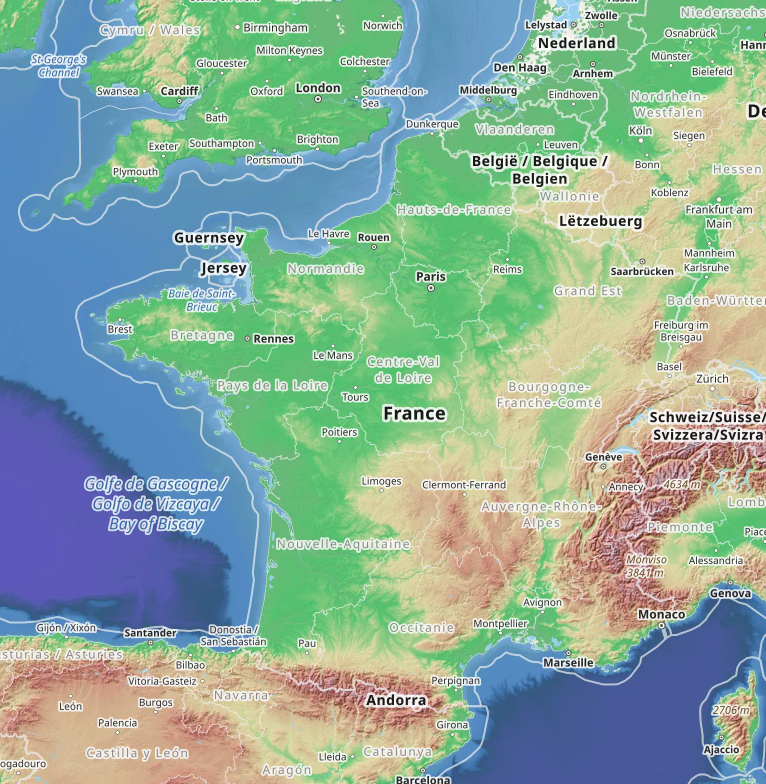
For both of the crew members, the French 🇫🇷 language is a true language barrier! Yes, it is! One of us is very capable of English, Dutch & Spanish, the other Dutch, German, English, (A bit) Danish, Norwegian Swedish, Frysian, Ost/West-Frysian (Yes, those are different from Frysian!) and a handfull of Dutch dialects. But no French 🇫🇷. We are very sorry for that, but it just does not stick..... And that implies large effort will be made to understand and make understood while on our way. And any help is welcome, so use cheat-sheets. This way, it should be possible to communicate in a way that keeps everybody safe and sound.
And, actually this also can be used in Belgium 🇧🇪! Because in Wallonia Belgians 🇧🇪 speak french.
The cheat-sheets are here! If it can help us, it might be able to help you. I am sure that there will be something that might be of help.
But first, let us start to explain some things about French 🇫🇷 and the waterways.
France: Freycinet standard dimensions (Freycinet gauge)
The waterways in France 🇫🇷 are mostly Freycinet gauge waterways. The Freycinet gauge (named after Minister Charles de Freycinet) is the classic French standard from 1879 for the dimensions of locks and ships on the main canals.
The Impact of the Freycinet Gauge:
The introduction of this standard had a profound effect on European inland shipping:
- Modernization & Connectivity: It led to the massive modernization of the French canal network, with nearly 5,800 km of waterways eventually conforming to the standard.
- Increased Capacity By standardizing lock sizes to 39 x 5.2 meters, it allowed larger barges (up to 350 tonnes) to navigate through previously disconnected regions, doubling canal traffic by the early 20th century.
- European Classification The Freycinet gauge remains relevant today as the basis for Class I in the Classification of European Inland Waterways.
What about Size?
- Lock dimensions: 39 meters long and 5.20 meters wide.
- Maximum vessel dimensions: To pass through the locks safely, your vessel must be a maximum of 38.50 meters long and 5.05 meters wide.
- Draft: The official draft is 1.80 to 2.20 meters, but in practice, you should account for only 1.40 to 1.60 meters on many canals due to silting.
- Air draft: The standard is 3.50 meters at the center of the arch.
Freycinet Locks: Why the Bridge is at the Lower Side
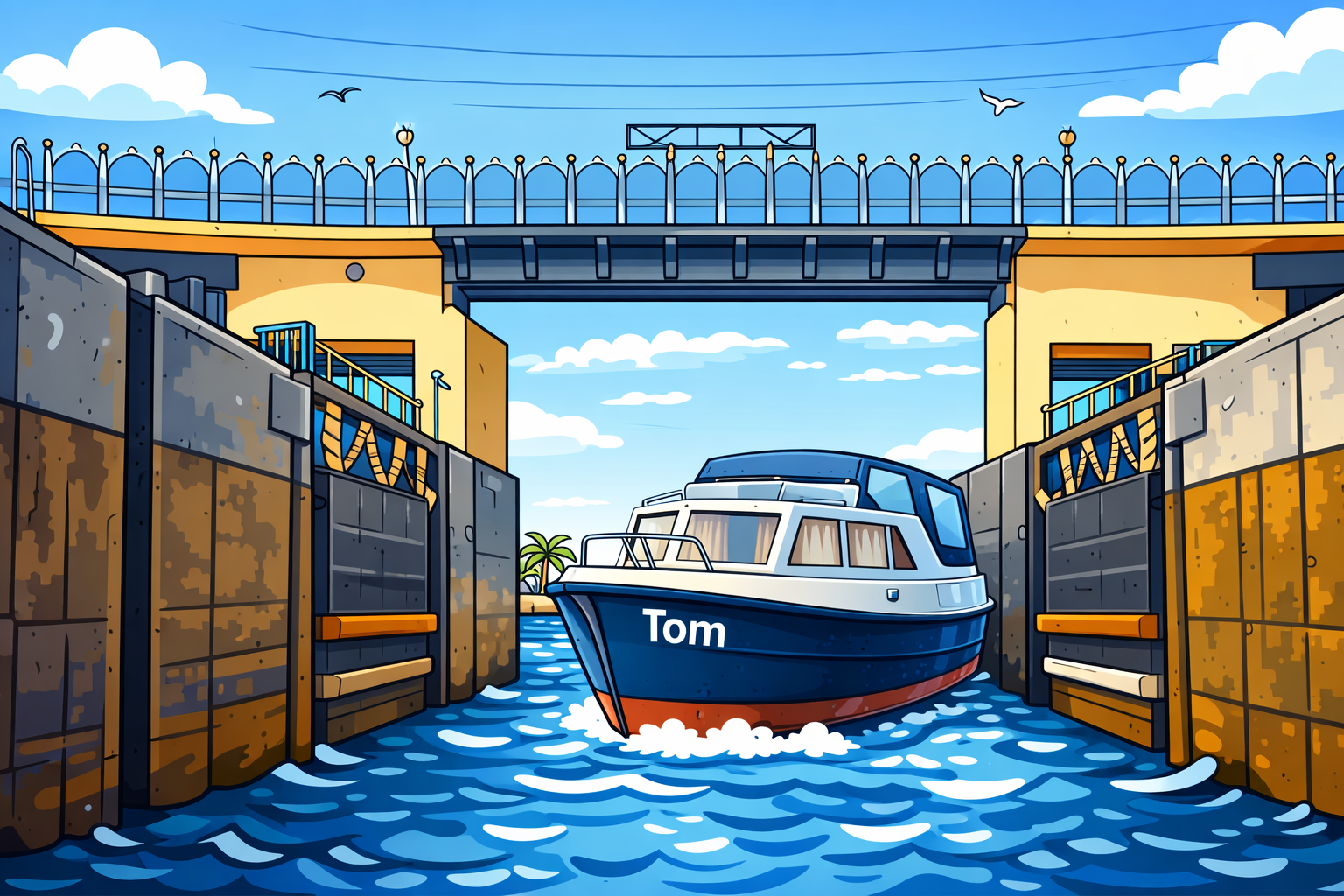
In France, almost all Freycinet standard locks feature a (foot/pipe/road)bridge at the lower side (downstream). This design is strategically chosen for the following reasons:
1. Maximum Vertical Clearance
As seen in the image of the boat "Tom," the water level is at its lowest point on the downstream side. This provides the maximum possible "air draft" (distance between the water and the bridge), allowing vessels to pass underneath safely without building an incredibly high or expensive bridge structure.
Maybe a little calculation example will help. The following variables are in place:
- Your boat air-draft: 2.50 meter
- You come in on the HIGH end of the lock, so you will go down.
- In front of you, over the doors on the lower side, you see a bridge, approx 1 meters above your current waterlevel.
- The waterlevel will drop 3 meters in the lock
So, the bridge is already 1 meters above your current waterlevel, and you are going to go down 3 meters. That makes: 1 + 3 = 4 meters between waterlevel and underside of the bridge. And your boat is 2.50 meters. Hm... You have then 4 - 2.5 = 1.5 meters of space above your boat. So always remember: When I see a to low bridge, but I still have to go down, you (probably) will be fine. Or you haven't paid attention checking your water-charts/maps/apps.
Rule of thumb: To easily figure out if you are climbing or descending, look at the position of the bridge relative to the lock. If you pass under a bridge first and then enter the lock chamber, you are on the "low" side and will be heading UP. Conversely, if you enter the lock first and see the bridge ahead of you at the far end, you are on the "high" side and will be heading DOWN.
2. Constant Accessibility
At the upper side of the lock, the water level changes significantly. By placing the bridge at the lower side, the clearance remains constant and the bridge stays accessible and dry for lock keepers and pedestrians, regardless of whether the lock chamber is filling or emptying.
Structural Efficiency
Placing the bridge at the lower end allows it to align more naturally with the surrounding towpaths and terrain. This avoids the need for steep ramps or stairs that would be required if the bridge were placed where the water level (and the land) is much higher.
Summary: The lower side offers the most space for the boat's cabin while ensuring a practical crossing point for people.
What is a "Freycinet-spits"?
In English, a spits is most commonly referred to as a péniche or a Freycinet barge.
- Definition: It is a steel, motorized inland waterway barge specifically designed to maximize cargo space while fitting precisely into Freycinet-standard locks.
- Standard Dimensions: To fit the locks, these vessels typically have a maximum length of 38.5 meters, a width of 5.05 meters, and a draught of 1.8 meters.
- Modern Use: While many original barges have been replaced by larger commercial vessels, hundreds of Freycinet barges are still in use today as hotel barges, live-aboards, or for transport on smaller canals.
Documents
You need to have specific documents:
Recueil RGP (PDF)
Documents for Region North-east
Important waterway publications
And we certainly don't want to keep this from you: Canal Locks Information
French Cheat sheets
24 Januari 2026
Communication with objects/marina's
Whenever you have a VHF radio, you can use that to communicate with people that are working at/on/near objects, like bridges, locks, but also marina's and ship-elevators. Most of the time they communicate in their native language. And as mentioned already earlier, our English is not that good. Hence these cheat-sheets.
VHF Radio Phrases: Dutch, French & English
This sheet is about commonly used communications with objects like bridges and/or locks.
| Nederlands | Frans (VNF Standard) | English (Standard) |
|---|---|---|
| Sluis [Naam], hier motorjacht [Naam]. | Écluse [Nom], ici le yacht à moteur [Nom]. | Lock [Name], this is motor yacht [Name]. |
| Ik kom van bovenstrooms / benedenstrooms. | Je viens de l'amont / de l'aval. | I am coming from upstream / downstream. |
| Ik wil graag schutten naar beneden/boven. | Je demande l'éclusage vers l'aval / l'amont. | I request locking downstream / upstream. |
| Wat is de wachttijd voor de sluis? | Quel est le temps d'attente pour l'écluse ? | What is the waiting time for the lock? |
| Mag ik invaren? | Est-ce que je peux entrer ? | May I enter the lock? |
| Ik begrijp het / Begrepen. | C'est reçu / Bien reçu. | Received / Roger. |
| Kunt u dat herhalen? | Pouvez-vous répéter, s'il vous plaît ? | Please repeat / Say again. |
| Ik zoek een ligplaats voor één nacht. | Je cherche une place pour une nuit. | I am looking for a berth for one night. |
French Numbers & Waiting Times (VHF)
After you've transmitted your request, you will get an answer. Most of the time it is about the time it will take to service your request. This means: Numbers.
| Number | French | Pronunciation (approx.) | VHF Context / Translation |
|---|---|---|---|
| 1 | Un | Uh | 10 minutes (dix minutes) |
| 2 | Deux | Deuh | 15 minutes (quinze minutes) |
| 3 | Trois | Trwa | 20 minutes (vingt minutes) |
| 4 | Quatre | Katr' | 30 minutes (trente minutes) |
| 5 | Cinq | Sank | One hour (Une heure) |
| 6 | Six | Sies | Noon (Midi / 12:00) |
| 7 | Sept | Set | Midnight (Minuit / 00:00) |
| 8 | Huit | Wiet | Half (Demie / half an hour) |
| 9 | Neuf | Neuf | Quarter (Quart / quarter hour) |
| 10 | Dix | Dies | Now (Maintenant / Direct) |
| 11-20 | onze douze treize quatorze quinze seize dix-sept dix-huit dix-neuf vingt | - | Useful for times and berths |
French Waterway Signage (Signalisation Fluviale)
| French Term | English Translation | Context / Action |
|---|---|---|
| Interdiction de passer | No Entry / Passage Prohibited | Usually shown by a red-white-red horizontal board or two red lights. |
| Arrêt obligatoire | Compulsory Stop | Stop before this point (often near locks or bridges). |
| Ne pas créer de remous | No Wake / Do Not Create Wash | Slow down significantly to protect banks or moored boats. |
| Défense de stationner | No Berthing / No Mooring | Do not tie up your boat in this area. |
| Défense d'ancrer | No Anchoring | Prohibited due to underwater cables or pipes. |
| Vitesse maximale | Maximum Speed | Follow the number shown (usually in km/h). |
| Attention | Caution / Danger | General warning sign (yellow diamond or exclamation mark). |
| Écluse en travaux | Lock under construction | Expect delays or closures. |
Support the KNRM!
Help them to help others!

I would like to ask you to become a donor for the KNRM.
The KNRM is a fully private organisation, completely run by volunteers, financed by contributions and donations. You will find all information about them on the website.
You can choose from a single one time payment or a monthly or yearly donation. Please Support them.
Our personal opinion is that every person out on the water should, by law be told to make a donation of €25,- per year. But that is just our opinion.
Copyright, Disclaimer & Attribution
The legal stuff needed because of stupid....
The content on this website may include materials such as text, images, videos, and other media that are the property of their respective owners. All trademarks, logos, and copyrighted works remain the intellectual property of their original creators.
We strive to properly attribute and acknowledge all sources. If you are the copyright owner of any material featured on this site and believe it has been used without appropriate credit or permission, please contact us at [your contact email] so we can promptly address the issue.
Where applicable, the use of third-party content falls under fair use, creative commons licenses, or other applicable legal provisions. If specific attribution is required, it is provided directly alongside the respective material.
The images and data on this site are NOT intended for navigation or critical decision-making. Any reliance on this information is strictly at your own risk. The information on this site is for PERSONAL USE ONLY. You may print or copy parts of it for your own private use. Commercial use is strictly FORBIDDEN. Do not sell, rent, or use this data for profit. Unauthorized commercial exploitation will be met with rigorous legal action to the fullest extent of the law Furthermore, automated data scraping, harvesting, or feeding this content into large language models or AI systems is strictly PROHIBITED. If automated tools crawl this site without express written permission, access will be blocked, and those responsible will be held liable for unauthorized bandwidth usage and intellectual property infringement.
Powered by Haringstad
Build with VIM
© Haringstad, J and S van Koll