Yes, here you find all information regarding fuel system issues. Due to the extensive issues
that might arise when underway, it is smart to have a separate section for that.
And here we try to put all those issues in one single page. Dry stuff, we know. But helpful
when you are stuck.
The Fuel System
Diesel Fuel Systems explained
Core insights
A Diesel fuel system consists of two
sections: Low pressure and High pressure.
Diesel Fuel Filters come in pairs: Course Filter (Primary fuel filter)andFuel Fine Filter (Secondary Fuel Filter)
The fuel system is the "food" for your engine. Without anything to "eat", the engine will not run at all.
So it is important to make sure your fuel system is in the best condition possible.
So that implies that you should perform "maintenance" on your fuel AND fuel system, because that is mandatory nowadays.
As already indicated, a diesel fuel system consists of two sections: a low-pressure section
(approximately equal to atmospheric pressure) and a high-pressure section. Most problems
occur in the low-pressure part of the fuel system. It is therefore important to take this into account.
What kinds of problems can you encounter
We will discuss the consequences later.
Water in your fuel. (This can occur with both diesel and gasoline!)
Bacteria in the diesel. This mainly occurs in diesel variants that contain blended “biological” components.
Contamination in the fuel (rust and other substances that do not belong there).
For this reason, a diesel system contains at least one, but most of the time several filters in the low-pressure system.
These are specifically intended to ensure that substances which could damage the fuel injection pump
and/or the injectors are filtered out of the fuel.
So how is a diesel fuel system constructed?
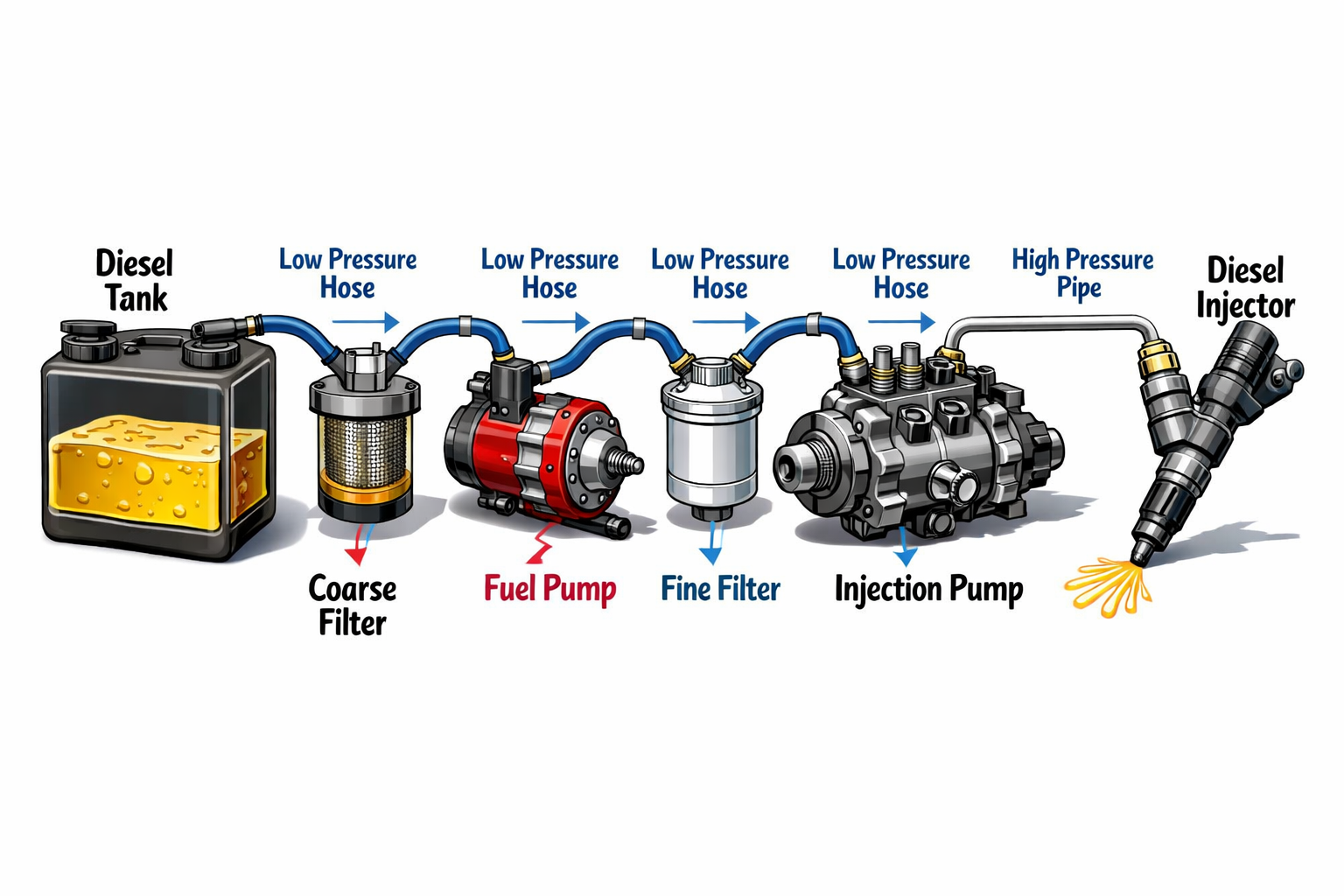
A diesel fuel system consists of the following components (as shown in Fig. 1):
The fuel tank. This tank contains the fuel and usually has a double valve at the bottom.
One of these valves is used to drain water, and the other is used to shut off the fuel supply
to the engine.
A low-pressure line (hose or metal pipe) running from the tank to the coarse fuel filter.
The coarse fuel filter, which consists of two parts:
The coarse filter, which removes large particles from the fuel.
The water separator. Because diesel is lighter than water, water settles at the bottom
of the filter. In the glass section of the filter you can see whether there is water in the
fuel and drain it from there.
A low-pressure line (hose or metal pipe) running from the coarse fuel filter to the fuel lift pump.
The low pressure fuel pump. This pump draws the fuel from the tank, through the coarse filter,
and delivers it to the fine filter.
A low-pressure line (hose or metal pipe) running from the lift pump to the fine fuel filter.
The fine fuel filter. This filter removes even smaller particles from the fuel, including
wear particles from the fuel lift pump.
A low-pressure line (hose or metal pipe) running from the fine fuel filter to the fuel injection pump.
The fuel injection pump.
High-pressure fuel injection lines (metal pipes) running from the injection pump to the injectors.
The injector.
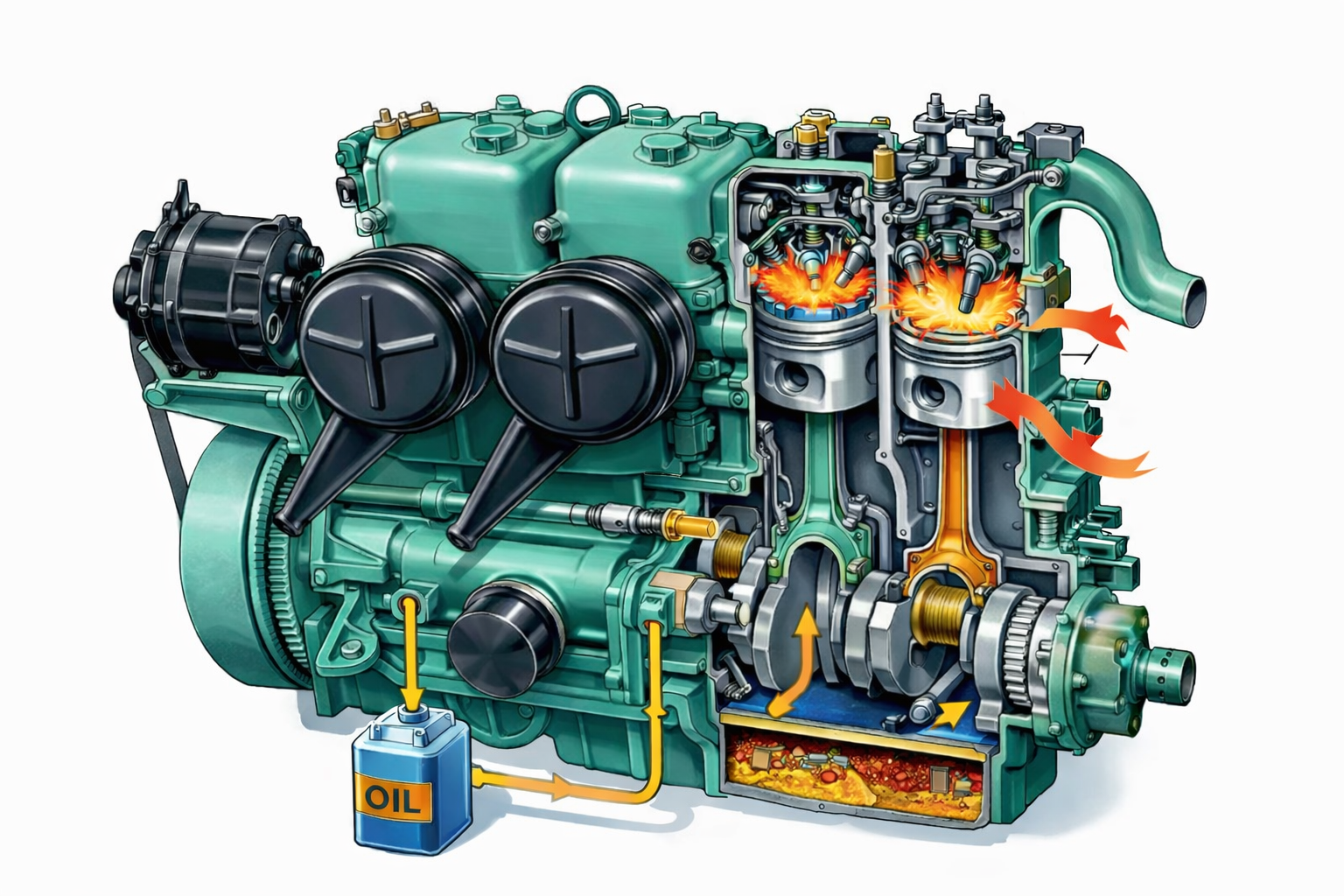
Fig.5 - Diesel engine playful
Consequences
Now the main "flow" of your diesel fuel system is clearly explained and we have addressed what can cause issues,
finding issues within the fuel-system becomes way easier now. But first let's talk about the consequences
of the 3 main issues
Water in your fuel
This will cause severe problems with your engine. It causes
corrosion and it even might block your (fine) filter(s). On top of that, water does not burn, so
your engine will not run. But it may also the beginning of something way more problematic!
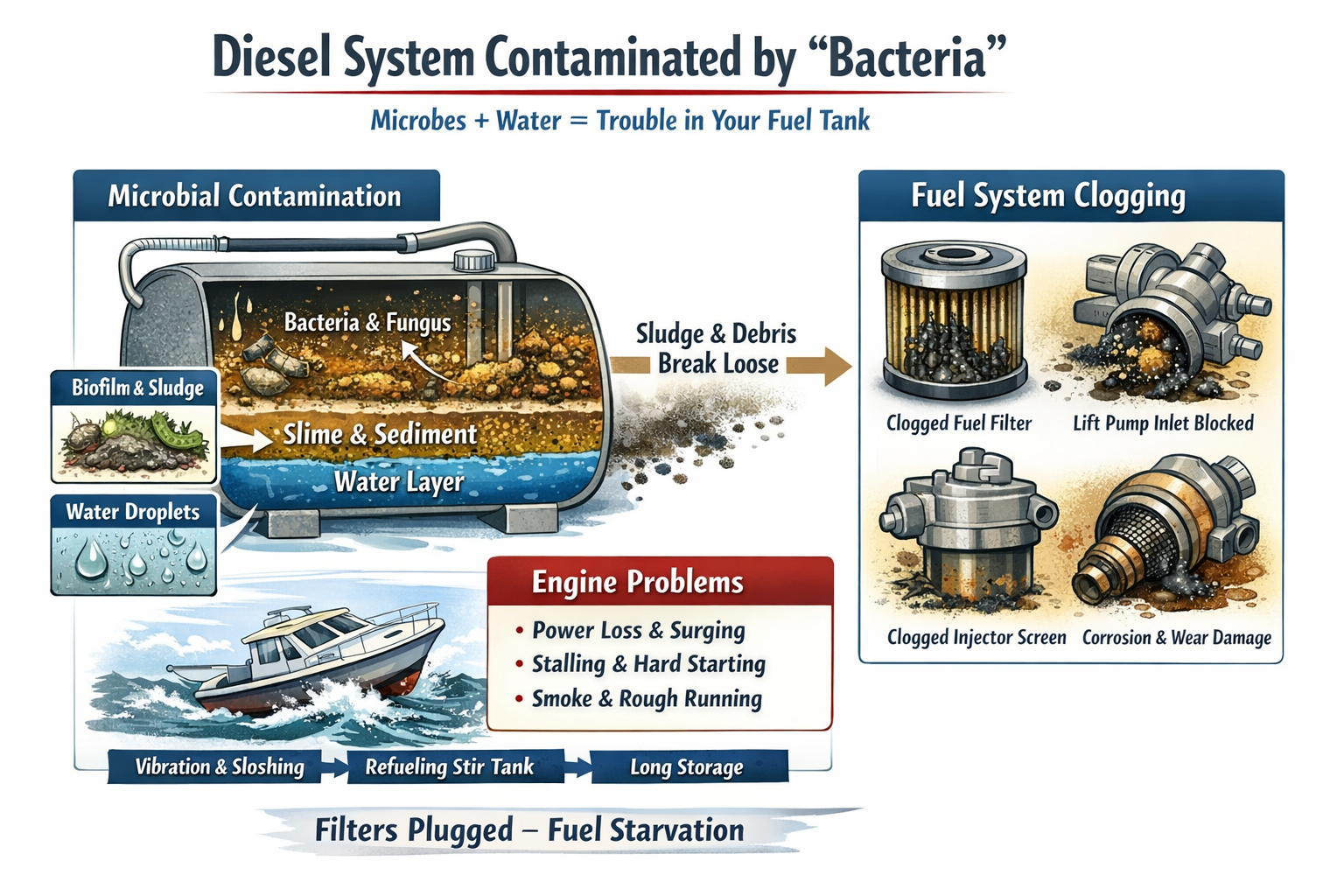
Diesel “bacteria” (microbial contamination): what it is and why it happens
What boaters call “diesel bacteria” is usually a mixed colony of bacteria + fungi (yeast/mold) that
lives where diesel fuel and water meet. Diesel itself isn’t “full of water,” but water gets into the
tank via condensation, leaky deck fills, bad vents, contaminated fuel, or long storage. Once a water layer or even
droplets exist, microbes can grow, feed on fuel components, and multiply.
Fig.6 - Diesel Contamination
The colony produces slime/biofilm and acidic byproducts. That slime and the loosened debris it traps
are what typically cause the operational problems: filter plugging, restriction, and in severe cases fuel starvation.
Where it lives in the system (and how it spreads)
Tank bottom / low spots: water settles low, so growth usually starts at the bottom of the tank,
especially around baffles, pickup tubes, and corners.
Fuel-water separator bowl: if water is not drained, the separator becomes a perfect growth zone.
Lines and fittings: biofilm can coat hose walls and metal lines, then release “strings” or flakes
of slime into flow.
Return line (if fitted): warm returned fuel can accelerate growth conditions and stir sediment.
Injection pump / lift pump inlet screens: fine screens can clog with gelatinous material before
the “main” filter even looks terrible.
What contaminated diesel looks/smells like
Dark or hazy fuel (sometimes looks like tea or cloudy beer).
Stringy/slimy debris in a sample jar, especially after it sits.
Black/brown “mud” or soft tar-like sediment on the bottom of the tank or separator.
Water layer in the sample jar (clear layer at the bottom) or visible water in the separator bowl.
Sour/“varnish” odor (not always present), sometimes a swampy smell if growth is heavy.
Note: “black stuff” can also be tank corrosion products or degraded rubber hoses, but microbial contamination is a
very common source—especially if water is present.
How clogging actually happens (the step-by-step failure chain)
Water enters and settles (or forms by condensation). A water/diesel interface appears.
Microbes colonize the interface and build a biofilm (slime) that sticks to tank surfaces.
Slime traps particles (rust, dust, asphaltenes, old varnish), creating a thicker “mat.”
Vibration, motion, or fueling stirs the tank. Biofilm flakes and sludge break loose.
Filters become the collection point. The primary filter/water separator loads up fast.
Restriction rises. Lift pump works harder; flow drops; engine runs lean on fuel (fuel starvation).
Secondary/fine filters clog next. If they plug, the injection pump may be starved.
Engine symptoms escalate from occasional hesitation to repeated shutdowns under load.
Common clogging points and the problems they create
1) Tank pickup tube / pickup screen
Many tanks have a pickup tube that stops slightly above the bottom, sometimes with a small strainer. Sludge can
accumulate around it, or stringy biofilm can “sock” the inlet.
Effect: intermittent restriction; often worse in rough water or after refueling.
Symptom: engine runs fine at idle but dies when throttled up.
2) Primary filter / fuel-water separator
This is usually the first component to visibly show the problem because it is designed to catch water and debris.
Effect: rapid filter plugging; water bowl fills; flow restriction increases.
Symptom: loss of power under load, surging, then stall; frequent filter changes needed.
3) Lift pump inlet / inlet screen
Some systems have a small screen at the lift pump or banjo bolt. Gelatinous material clogs it surprisingly quickly.
Effect: fuel starvation even if the main filter looks “not too bad.”
Symptom: hard starting and inconsistent fuel delivery; may improve briefly after sitting.
4) Secondary (fine) filter near the engine
Anything that passes the primary filter can finish clogging the fine filter, especially during an active “sloughing”
phase after the tank is disturbed.
Effect: injection pump starvation; very poor running or no-start.
Symptom: engine may start, run briefly, then die as the filter loads.
5) Injection pump / injectors (secondary damage)
The microbes themselves aren’t “chewing” metal parts, but contamination can indirectly cause wear and corrosion.
Effect: reduced lubrication from water, corrosion from acidic byproducts, abrasive debris passing through.
Symptom: rough idle, smoke changes, poor power even after filters are replaced (in more severe cases).
Typical engine symptoms you’ll notice
Loss of top-end power (can’t reach normal RPM under load).
Surging or hunting as the engine alternates between enough fuel / not enough fuel.
Stalling especially when you push the throttle or when seas are choppy.
Hard starting or “starts then dies” behavior.
More frequent filter changes and a filter that looks slimy, dark, or unusually fast to clog.
Air-like symptoms (because restriction can cause cavitation and tiny bubbles on the suction side).
Other problems besides clogging
Corrosion and acidity
Microbial metabolism can create acids and promote pitting corrosion, especially in
steel tanks and at water-contact areas. Aluminum tanks can also suffer depending on conditions and contaminants.
Sludge accumulation and “tank becomes the filter”
Over time, sludge can build into thick mats. When disturbed, it breaks apart and overwhelms filters. This is why a
“perfectly fine” engine can suddenly start dying after a rough passage or after topping up the tank.
Water problems (separate but related)
Water reduces diesel’s lubricity and can damage pumps/injectors. In cold conditions, free water can also contribute
to icing or waxy blockages (depending on climate and fuel), compounding restriction issues.
Seal/hose compatibility and debris
Some contaminants and older hoses shed material that looks like microbial debris. Microbes can also live in biofilm
on hose walls, so even after draining the tank, the system can “re-seed” if hoses and filters aren’t addressed.
Why issues can get worse right after adding biocide or “killing the bug”
When a biocide works, it kills colonies and breaks biofilm loose. That dead biomass becomes
particulate load. It is common for filters to clog faster for a while after treatment because the
system is finally shedding what was stuck to the tank walls.
Practical consequence: you may need multiple filter changes in the first hours/days after treatment.
Risk: if you treat a very dirty tank and then immediately go offshore, you can get repeated fuel starvation.
Severity spectrum: from mild to “engine won’t run”
Mild: small water presence, light haze, occasional separator water, slightly faster filter loading.
Moderate: visible slime/sludge, recurring clogged primary filter, power loss when throttling up.
Severe: thick sludge mats, pickup tube plugging, rapid clogging of both filters, repeated stalls,
possible pump/injector damage from water/contaminants.
Quick, practical checks (no lab required)
Sample test: draw fuel from the bottom of the tank (or drain) into a clear jar; let it sit 30–60
minutes. Look for water at the bottom and stringy debris.
Separator inspection: check and drain the water bowl; note any slime or dark mud-like material.
Filter autopsy: cut open an old filter (safely) and look for dark gelatinous deposits or slime.
Vacuum/restriction clue: if you have a vacuum gauge on the filter head, rising vacuum indicates
restriction and impending clogging.
Operational risks (what makes it show up at the worst time)
Rough water / vibration: shakes sludge loose and stirs water from the bottom.
Refueling: incoming flow stirs the tank and can lift sediments into suspension.
Warm return fuel: can encourage growth and keep contamination mobile.
Long storage: more time for condensation and growth; the first trip after storage is a common trigger.
Summary: the key failure mode
A diesel microbial problem is primarily a water + biofilm + debris problem. The colony grows at the
water/fuel interface, creates slime and acids, and traps sediment. When the tank is disturbed, that material breaks
free and the fuel system’s filters and small screens become the choke points. The result is progressively
worse restriction, leading to surging, power loss, and stalls—often most noticeable under load and often
“sudden” after seas/refueling/treatment.
Diesel fuel “debris issue”: what it is and what happens
A debris issue means solid particles (rust, dirt, tank scale, microbial sludge, paint flakes, rubber bits, gasket
fragments) are moving through the fuel path. As debris migrates, it progressively restricts flow and can also damage
precision components (injection pump and injectors). The common end result is fuel starvation:
the engine can’t get enough clean fuel at the right pressure, at the right time.
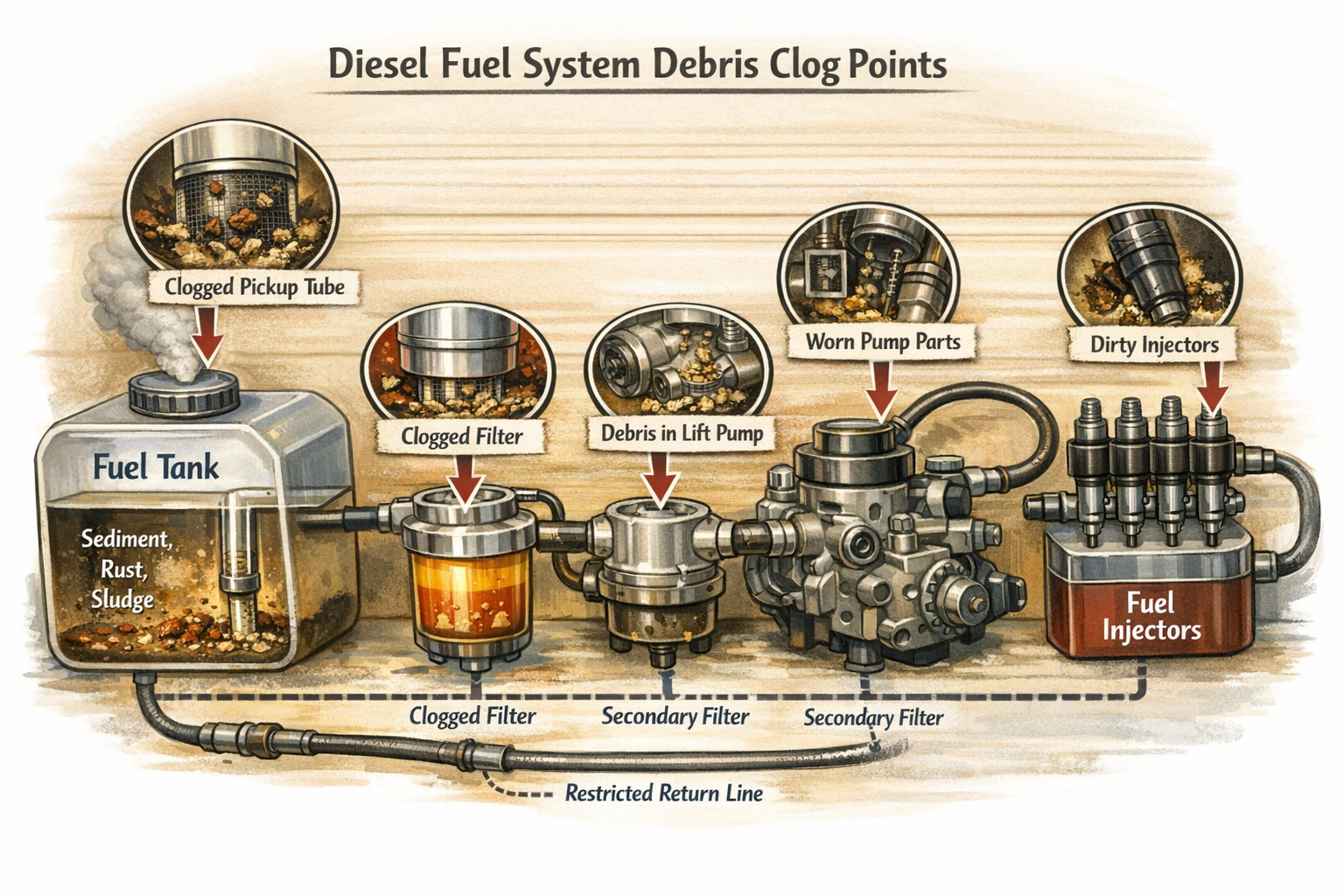
Fig.7 - Debris in fuel
On a typical marine diesel, fuel travels from the tank → pickup tube/screen →
primary filter/water separator → lift (feed) pump → secondary (fine) filter →
injection pump → injectors, then excess returns via a return line.
Debris can clog or abrade parts anywhere along this route.
Where the debris comes from
Tank corrosion & scale: rust and flakes from steel tanks; aluminum oxide or coating flakes from other tanks.
The pickup is the first choke point. A partial blockage causes high suction at the inlet, pulling more debris toward
the screen—like a vacuum cleaner bag slowly sealing over. In rough water, debris gets stirred up and the problem
becomes intermittent.
Typical symptoms: runs fine at idle, dies under load; improves after sitting (debris falls away), then returns.
Failure mode: “soft” blockage that worsens with demand; sometimes feels like air in the system.
2) Primary filter / water separator (coarse filtration)
This is designed to catch water and larger solids first. With debris, it loads up and the pressure drop across the
element increases. You may see a vacuum/pressure gauge trend upward (if fitted) and the bowl can show dark sludge
or water.
Typical symptoms: progressive loss of power; engine surges; filter bowl looks dirty; frequent filter changes needed.
Other problems: water present encourages microbial sludge; sludge can “plug” the element rapidly after a tank stir-up.
3) Lift (feed) pump inlet screen / check valves
Many mechanical lift pumps have tiny screens or valves that can stick when contaminated. Debris here reduces pump
capacity and may prevent proper priming.
Failure mode: pump cavitation or weak output; air leaks become more noticeable because suction rises.
4) Secondary (fine) filter (final filtration before injection)
This filter protects the injection system. If the primary doesn’t catch everything—or if it’s bypassed/incorrect—
the secondary can clog quickly. Fine filter restriction most strongly shows up at higher RPM/load.
Typical symptoms: will idle and run at low revs, but stumbles, smokes, or shuts down when you throttle up.
Danger: if debris is fine enough to pass the secondary, it may reach the injection pump/injectors.
5) Injection pump inlet / metering passages
Injection pumps have tight tolerances. Debris can score plungers/barrels, stick metering valves, and cause erratic
fueling. Water or abrasive fines accelerate wear.
Typical symptoms: uneven running, hunting/surging, poor response, hard start even after filters are replaced.
Even small contamination can distort injector spray patterns. Instead of a fine mist, you get jets/dribble, which
burns poorly and can cause smoky exhaust and rough running.
Typical symptoms: knocking, misfire on one cylinder, white/gray smoke (poor combustion), black smoke under load (over/poor atomization).
Secondary damage: carbon buildup, hot spots, higher exhaust temperatures, piston/cylinder stress over time.
7) Return line restrictions
Debris can also restrict the return, raising case pressure in some systems. This can alter fueling behavior and
aggravate leaks at seals or fittings.
Typical symptoms: leaks that appear “suddenly,” inconsistent running after warm-up, strange pressure behavior if monitored.
Why debris problems are often intermittent (especially on boats)
Slosh & stir-up: wave action suspends sediment and sludge that usually sits harmlessly at the bottom.
“Self-clearing” pauses: when the engine stops, debris can fall away from the pickup or relax off the filter surface.
Temperature effects: cold fuel can be thicker; deposits and wax-like components can worsen restriction.
Common symptoms you’ll notice
Loss of power under load (most classic)
Surging/hunting at steady throttle
Engine stalls when throttling up or in rough conditions
Hard starting or needing repeated bleeding
Smoke changes (white/gray for poor combustion; black under load if injection quality is degraded)
Frequent filter plugging shortly after replacement
More bubbles in clear lines (if present), because restriction increases suction and can draw air through tiny leaks
Secondary problems caused by clogging (beyond “it stops”)
High suction → air ingress: restriction makes the system pull harder; tiny leaks that were harmless start sucking air.
Cavitation in the lift pump: fuel can vaporize locally when inlet pressure drops; reduces flow and can damage pump parts.
Injector & pump wear: abrasive fines/water reduce component life; can lead to persistent issues even after cleaning filters.
Overheating/sooting: poor atomization increases soot and carbon, stressing exhaust components and combustion chambers.
Unreliable priming: check valves stick; the system may lose prime after shutdown or filter changes.
Practical triage when you suspect debris (safe, general steps)
Reduce load immediately: throttle back to see if stable running returns (classic sign of restriction).
Check primary filter bowl: look for water, sludge, or heavy contamination; drain water if your unit allows it.
Replace filters in order: primary first, then secondary. Pre-fill with clean diesel if appropriate for your system.
Bleed the system correctly: remove trapped air at the specified bleed points (filter head, injection pump inlet, etc.).
Inspect for air leaks: wet fittings, cracked hoses, loose clamps; restriction magnifies these.
If filters clog again quickly: assume the tank is the source—avoid “infinite filter changes” and address tank contamination.
If you want, tell me your engine model and your filter setup (primary/secondary types), and I can tailor a
troubleshooting flow that matches your exact layout.
Prevention and long-term fixes
Keep water out: water drives microbial sludge—use good deck fill seals, keep tanks topped up when stored, drain separators regularly.
Use clean refueling practices: clean jerrycans, filtered funnel, wipe the fill area before opening.
Periodically inspect the tank: sample from the bottom; consider professional polishing/cleaning if recurring sludge appears.
Replace aging hoses: internal delamination can mimic debris problems and create “flap” restrictions.
Biocide only when indicated: if microbes are present, treat appropriately and be ready for rapid filter loading afterward.
The Fuel System Troubleshooting
Troubleshooting your Diesel Fuel System
Purpose of this troubleshooting plan
This step-by-step plan helps you determine where fuel flow is being restricted in a diesel system
using only basic tools and observations. It assumes no vacuum gauges, flow meters, or diagnostic electronics.
Just your senses, simple hand tools, and logical isolation of sections.
The method works for both solid debris contamination and bacterial (“diesel bug”) blockage.
Where the behavior differs, this is explicitly noted.
Step 1 – Analyze when and how the problem appears
Before touching anything, note the operating pattern. This already narrows the search.
Fails only under load / higher RPM:
restriction is upstream of the injection pump (pickup, filters, lift pump).
Runs normally at idle, dies after minutes at cruising RPM:
classic progressive clogging (filters or pickup screen).
Problem appears in rough water or after refueling:
tank-bottom debris or microbial sludge being stirred up.
Hard starting + repeated need to bleed:
lift pump valves, suction-side air leaks, or heavy biological slime.
Key distinction: bacterial blockages tend to worsen rapidly after disturbance and produce
dark, slimy residue; debris blockages tend to be more granular and slower to build.
Step 2 – Inspect and isolate the primary filter / water separator
The primary filter is your first and most informative inspection point.
Shut down the engine safely.
Visually inspect the filter bowl or housing.
Drain a small amount of fuel into a clear container.
Bacterial indication:
dark brown/black slime, stringy or gelatinous material, sour smell.
Replace the primary filter element and bleed the system.
If the engine now runs normally but fails again quickly,
the blockage source is upstream (tank or pickup).
Step 3 – Evaluate the secondary (fine) filter behavior
If replacing the primary filter does not restore stable operation,
the restriction may be at or beyond the secondary filter.
Replace the secondary filter element.
Carefully note how dirty the old element is.
Clean primary + dirty secondary:
fine debris passing through or biological fines slipping past the primary.
Both filters heavily fouled:
severe tank contamination (especially bacterial).
If the engine improves only briefly after secondary replacement,
expect ongoing contamination from upstream.
Step 4 – Identify pickup tube or tank outlet blockage
Pickup tube restrictions cause classic intermittent failures.
Without removing the tank, you can infer pickup problems by behavior:
Engine runs longer at half throttle than at full throttle.
Engine recovers after shutdown and restart.
Problem worsens when fuel level is low.
Debris: rust flakes or sediment temporarily sealing the pickup screen. Bacteria: slime mats that collapse onto the screen under suction.
If accessible, disconnect the pickup line at the tank and briefly check for free fuel flow
into a container (gravity-fed systems only). Weak or pulsed flow indicates obstruction.
Step 5 – Rule out hose collapse and internal delamination
Old rubber fuel hoses can fail internally and mimic debris blockage.
Problem appears only when warm or at higher RPM.
Fuel flow improves when hose is gently repositioned.
No visible external damage, but restriction persists.
Debris systems:
rubber fragments may appear in filters. Bacterial systems:
slime may adhere inside hoses, narrowing the bore.
Temporarily bypassing a suspect hose with a known-good line is a powerful diagnostic step.
Step 6 – Assess lift pump function by priming behavior
The lift pump does not usually “half fail”—it becomes inconsistent when restricted.
Manual priming lever feels weak or erratic.
System loses prime after shutdown.
Fuel delivery pulses rather than flows.
Debris:
particles jam check valves or inlet screens. Bacteria:
sticky biofilm causes valves to hang open or closed.
If the system primes easily downstream of the pump but not upstream,
the restriction is before the pump.
Step 7 – Check for return-line restriction
Though less common, a blocked return can distort system behavior.
Fuel leaks suddenly appear at seals.
Engine behavior worsens after warming up.
Return line feels unusually stiff or swollen.
Disconnecting the return briefly (into a container) should produce a steady trickle.
Poor or absent flow indicates blockage.
Step 8 – Determine if contamination reached injectors
Injector issues are usually downstream consequences, not the root cause.
Persistent rough running after all filters are clean.
At this stage, the upstream problem must be solved first—otherwise injector servicing will not hold.
Logical isolation summary
By changing one thing at a time and observing how long the improvement lasts,
you can determine where contamination is entering the system:
Short improvement after filter change → contamination upstream.
No improvement after filter change → restriction elsewhere.
Problem worsens with motion or load → pickup or tank bottom.
Rapid re-clogging with slime → bacterial growth.
This approach avoids guesswork, prevents unnecessary part replacement,
and leads you directly to the true source of the blockage.
Main Navigation
24 Januari 2026
We try to update this website as often as possible!
The upgrade plans
24 Januari 2026
Our upgrade plans.
Support the KNRM!
Help them to help others!
KNRM
I would like to ask you to become a donor for the KNRM.
The KNRM is a fully private organisation, completely run by volunteers, financed by contributions and donations.
You will find all information about them on the website.
You can choose from a single one time payment or a monthly or yearly donation. Please Support
them.
Our personal opinion is that every person out on the water should, by law be told to make a
donation of €25,- per year.
But that is just our opinion.
Copyright, Disclaimer & Attribution
The legal stuff needed because of stupid....
The content on this website may include materials such as text, images, videos, and other media that are the
property of their respective owners. All trademarks, logos, and copyrighted works remain the intellectual property
of their original creators.
We strive to properly attribute and acknowledge all sources. If you are the copyright owner of any material
featured on this site and believe it has been used without appropriate credit or permission, please contact us at
[your contact email] so we can promptly address the issue.
Where applicable, the use of third-party content falls under fair use, creative commons licenses, or other
applicable legal provisions. If specific attribution is required, it is provided directly alongside the respective
material.
The images and data on this site are NOT intended for navigation or critical
decision-making.
Any reliance on this information is strictly at your own risk. The information on this site is for
PERSONAL USE ONLY.
You may print or copy parts of it for your own private use. Commercial use is strictly FORBIDDEN.
Do not sell, rent, or use this data for profit. Unauthorized commercial exploitation will be met with rigorous
legal action to the fullest extent of the law
Furthermore, automated data scraping, harvesting, or feeding this content into large language models or AI systems
is strictly PROHIBITED.
If automated tools crawl this site without express written permission, access will be blocked, and those
responsible will be held liable for
unauthorized bandwidth usage and intellectual property infringement.