Partly restored documents
Here you find (parts) of documments regarding the Viksund 27, found on the internet.
The Tale of the Viksund 27: Certified and non certfied
On the first page of this site, we already gave you an insight of what the Viksund 27 is. Since nowadays it is a rather rare boat, we have collected information about it and created this page. We will, of course, continue to add information as we find it. So keep an eye on this page.
Viksund, however, was a very well known Norwegian Boat Builder, mainly know for its motor cruisers.
The Story Behind the Shipyard: Viksund Båt Nor AS
Before Tom was ever launched in 1978, the Viksund story began with one man’s determination to build boats tough enough for the unforgiving waters of the Norwegian coast.
From Wooden Boats to a Fiberglass Pioneer
In the 1950s, a young and ambitious boatbuilder named Erling Viksund learned his craft working at various shipyards across Norway. At the time, traditional wooden boats ruled the fjords, requiring endless seasonal maintenance. Erling saw the future in a revolutionary new material: GRP Glass Reinforced Plastic (fiberglass). A strong, lightweight, and low maintenance composite material that revolutionized boatbuilding in the 1960s. . In 1966, he took a leap of faith and founded his own company, Viksund Båt Nor AS, on the island of Askøy A rugged coastal island municipality located just northwest of Bergen in Western Norway, surrounded by exposed North Sea waters. , just outside Bergen.
Conquering Skepticism
Convincing seasoned Norwegian fishermen and sailors to trust “plastic” boats over traditional timber was no easy task. Erling knew that the only way to win them over was to build every hull far stronger than necessary. By laying up thick, durable fiberglass, often 35 to 40 mm thick, Viksund quickly earned a reputation for building virtually indestructible vessels that could handle the brutal weather of the North Sea with ease.
The Sjark and the Birth of the Columbi
Viksund’s first major breakthrough came with the Viksund Sjark, a modern fiberglass take on the traditional Norwegian sjark A traditional, sturdy Norwegian coastal fishing vessel characterized by a forward wheelhouse and a spacious open working deck at the stern. . Commercial fishermen loved its unmatched stability and low maintenance.
By the 1970s, as recreational boating grew in popularity across Scandinavia and Europe, Erling applied that same commercial grade DNA to family cruisers. Alongside the famous 31 Goldfish, the Viksund 27 Columbi became a cornerstone of the yard’s success. Designed with classic spitsgatter A traditional Scandinavian hull design where both the bow and the stern are pointed, offering superior tracking and safety in following seas. lines, it gave families a safe, roomy, and remarkably seaworthy cruiser that felt just as at home on the Dutch inland waterways as it did in the Norwegian fjords.
A Lasting Maritime Heritage
Over the following decades, Viksund continued to innovate, introducing popular lines like the Futura and the luxury St. Cruz series. While changing economic tides eventually brought production at the original yard to a close in 2012, the Viksund legacy is far from over.
Today, thousands of Viksund vessels are still actively cruising worldwide. Whether crossing open seas or enjoying peaceful weekends out of Andijk, owning a Viksund means being part of a proud tradition of Norwegian craftsmanship built to last for generations.
One Hull, Four Boats: The Development of the Viksund 27
When Erling Viksund designed the 27 foot hull in the late 1960s, he created one of the most versatile platforms in Scandinavian boatbuilding. Inspired by the classic Norwegian Colin Archer A legendary Norwegian naval architect famous for designing heavy, double ended rescue vessels and pilot boats built to survive the worst North Sea gales. lines, this single heavy duty hull was adapted into four distinct models, serving both commercial fishermen and cruising families.
How They Were Built
Production was split between Viksund’s main facility in Strusshamn near Bergen and a dedicated northern factory at Rødskjær near Harstad, which was established specifically to meet the huge demand for fishing boats. Every hull was hand laid in thick GRP Glass Reinforced Plastic (fiberglass), laid up to 35 mm thick on the sides and bottom and reinforced to 40 mm along the keel and high stress areas. with internal stringers and bulkheads bonded directly into the hull while the resin was still curing, creating a rigid, monolithic structure.
The Four Variants of the Viksund 27
Depending on the deck mold, keel ballast, and interior layout installed on top of the 8.23 meter hull, the Viksund 27 became four boats in one:
- 1. Viksund 27 Columbi (Cruiser): Built primarily for family cruising, the Columbi featured a spacious aft cockpit, a bright wheelhouse salon, and sleeping quarters forward. With roughly 400 kg of internal ballast and the engine tucked neatly under the cockpit floor, it offered quiet, comfortable coastal and inland cruising.
- 2. Viksund 27 MS (Motorsailer): Designed for sailors who wanted offshore capability without sacrificing comfort, the MS carried a masthead rig A sailboat rig where the forestay runs all the way to the very top of the mast, keeping the sail area lower and easier to handle in strong winds. and a heavy 1,000 kg external steel keel. This brought the total weight up to around 4,000 kg and gave the boat remarkable stability in heavy seas.
- 3. Viksund 27 Old Sjark (First Generation): The early commercial fishing version used the classic rounded hull with a forward wheelhouse and a deep, self draining open working deck aft. Unlike the Columbi, the engine was mounted forward inside the wheelhouse, freeing up the entire aft section for fishing gear and catch holds.
- 4. Viksund 27 New Sjark (Updated Generation): Introduced in the late 1970s and early 1980s, the updated Sjark featured a modernized, taller wheelhouse with improved visibility, wider side decks, and higher bulwarks. These refinements gave coastal fishermen better weather protection and extra buoyancy when hauling heavy nets.
How Many Were Built?
Across its production run from 1970 through the early 1980s, the Viksund 27 was one of the yard’s biggest commercial successes. According to Norwegian maritime archives and Båtmagasinet, roughly 700 units of the Viksund 27 Columbi and MS were produced, alongside several hundred commercial Sjark versions. Out of the roughly 6,000 vessels Viksund built over its entire history, the 27 foot series remains the iconic backbone that put the yard on the international map.
SOLAS Standards and Sea Safety
Safety at sea was always Erling Viksund’s guiding principle, and the shipyard’s reputation for extreme structural strength led directly into commercial safety certification. While leisure versions like the 1978 Columbi predated modern European recreational directives, Viksund’s commercial hulls, lifeboats, and rescue tenders were engineered to meet strict maritime regulations, including SOLAS Safety of Life at Sea. An international maritime treaty administered by the International Maritime Organization (IMO) setting strict minimum safety, stability, and construction standards for commercial vessels and rescue craft. and the Norwegian Maritime Authority (Sjøfartsdirektoratet) rules for commercial fishing vessels. That same commercial grade reserve buoyancy, thick laminate, and self righting stability is built directly into the DNA of every Viksund 27 still afloat today.
Original Design
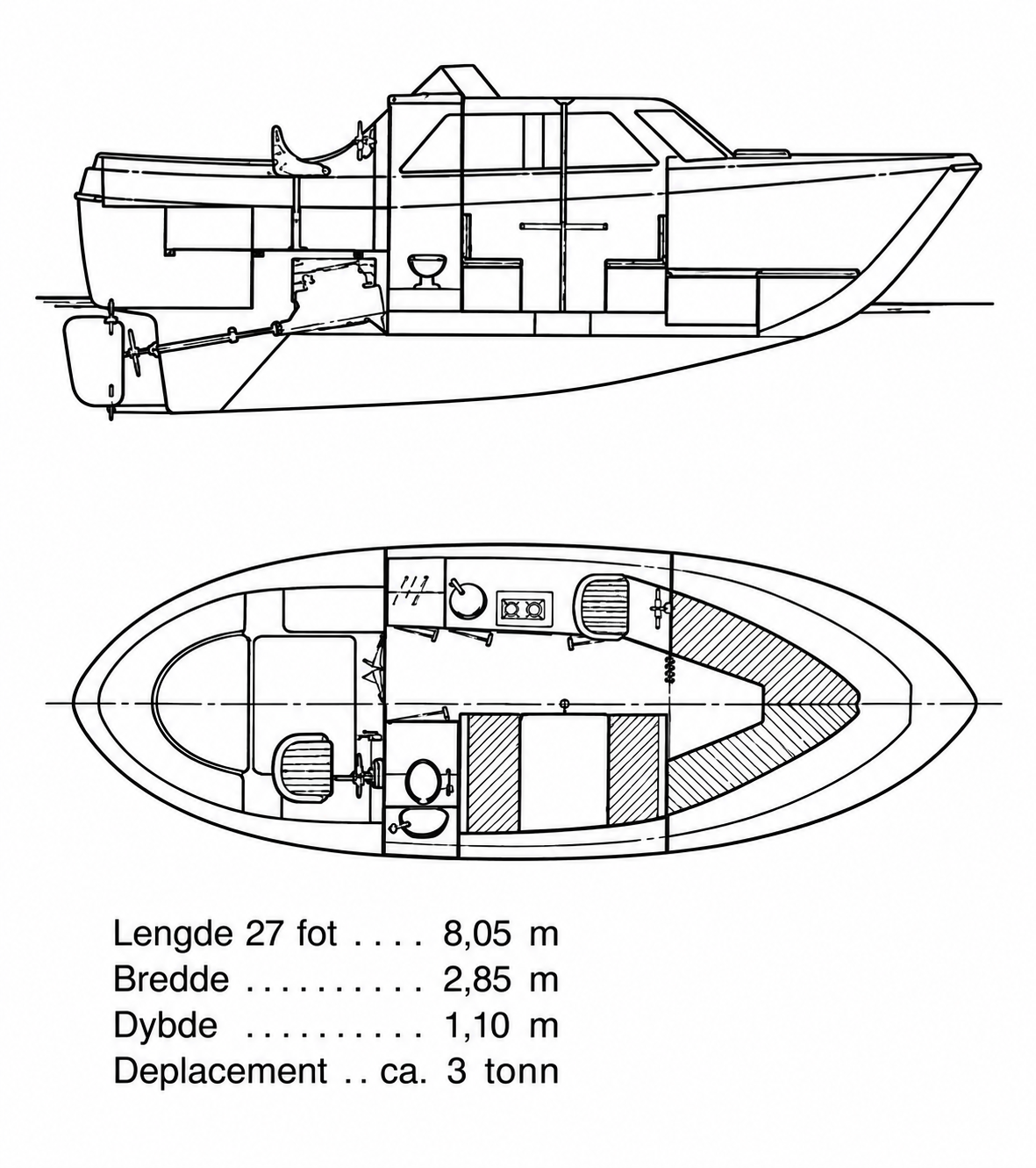
Here are the original design specifications of the Viksund 27 series.
Design Specifications
Material:GRP (Fiberglass)Length:8.23 meter (27 feet)Beam:2.85 meterHeight:2.40 meterDraft:1 meter (varies depending on ballast type)Hull Thickness:35 mm on the sides and bottom, with 40 mm in reinforced areas.Engine:18 to 45 hp (Volvo, Sabb, Yanmar)
Stock Engine: Volvo Penta MD2B 25 hp Diesel Engine.Speeds:8 - 9 knots with a Volvo Penta MD3B 36 hp Diesel Engine.Fuel Tank:Standard 60 or 100-liter Sabb tankWater Tank:50 to 100-liter tank (stainless steel)Weight:27 MS: approximately 4000 kg (1000 kg steel keel)
27 Columbi/Sjark: approximately 3400 kg (400 kg keel)Cost in 1973:69,900 NOK
(Equivalent to approximately 426,390 NOK (€52,000) today, adjusted for inflation)
The Specs pages
Support the KNRM!
Help them to help others!

I would like to ask you to become a donor for the KNRM.
The KNRM is a fully private organisation, completely run by volunteers, financed by contributions and donations. You will find all information about them on the website.
You can choose from a single one time payment or a monthly or yearly donation. Please Support them.
Our personal opinion is that every person out on the water should, by law be told to make a donation of €25,- per year. But that is just our opinion.
Copyright, Disclaimer & Attribution
The legal stuff needed because of stupid....